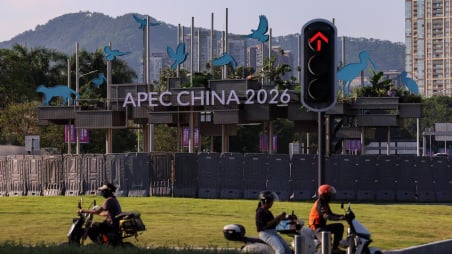
Attention will turn to China’s southern technology hub of Shenzhen next week as leaders of the United States, China and Russia gather for the 2026 Asia-Pacific Economic Cooperation (APEC) summit, amid growing geopolitical tensions and concerns over global trade and economic stability.
The 21-member economic forum is expected to provide an opportunity for discussions on trade, investment, energy security and international conflicts, with a possible meeting between US President Donald Trump, Chinese President Xi Jinping and Russian President Vladimir Putin attracting particular attention.
About APEC?
Founded in 1989 as an informal 12-member economic dialogue in Canberra, Australia, APEC has evolved into the Asia-Pacific region’s leading platform for promoting economic cooperation, trade and investment.
The grouping accounts for approximately 62 per cent of global gross domestic product and nearly half of international trade.
Unlike conventional international organisations, APEC refers to its members as “member economies” rather than countries. This arrangement allows both Chinese-ruled Hong Kong and Taiwan to participate, despite Beijing’s claim over the latter.
However, India, the world’s most populous country, is not a member of the forum.
APEC operates through non-binding agreements reached by consensus, with members voluntarily implementing commitments rather than being subjected to legally enforceable obligations.
The APEC Economic Leaders’ Meeting is scheduled for November 18 and 19, preceded by the annual APEC CEO Summit on November 17 and 18.
Why Shenzhen?
China is hosting the summit for the third time, following previous editions in Shanghai in 2001 and Beijing in 2014.
Shenzhen, one of China’s leading technology and commercial centres, will host this year’s gathering, placing the city at the centre of discussions involving some of the world’s most influential political and economic leaders.
Who will attend?
Chinese President Xi Jinping is expected to chair the leaders’ meeting and deliver remarks.
Other prominent attendees expected include US President Donald Trump, Russian President Vladimir Putin and Philippine President Ferdinand Marcos Jr.
Leaders from Canada, Australia, Mexico, Indonesia, Malaysia, South Korea and Vietnam are also expected to participate.
Taiwan has designated Acer founder Stan Shih as its representative, while Japan has yet to formally confirm whether Prime Minister Sanae Takaichi will attend, while New Zealand has also not officially announced its delegation.
Key issues to watch
Several geopolitical and economic issues are expected to dominate discussions at the summit.
Middle East instability: The economic consequences of conflicts in the Middle East are likely to feature prominently, particularly concerns over energy security, disruptions to international trade routes, supply chains and rising inflation.
US-China-Russia relations: A possible meeting involving Trump, Xi and Putin will be closely watched. However, analysts say China remains reluctant to engage in nuclear disarmament discussions because its nuclear arsenal is considerably smaller than those of the United States and Russia.
Washington and Moscow are also expected to focus on the war in Ukraine, although China may not necessarily be part of those discussions.
China-US trade relations: The stability of relations between Washington and Beijing will be another major issue. Analysts say both countries are falling short of commitments under their extended trade truce.
Disagreements over rare earth supplies, artificial intelligence and tariffs are expected to feature in discussions, while US arms sales to Taiwan will remain a sensitive issue.
China’s relations with Japan and the Philippines: Tensions between Beijing and Tokyo have persisted since November 2025, when Japanese Prime Minister Sanae Takaichi angered China by suggesting that Japan could deploy its military if a Chinese action against Taiwan also threatened Japanese territory.
Relations between China and the Philippines will also attract attention amid continuing confrontations and territorial disagreements in the disputed South China Sea.
Who are APEC’s members?
APEC comprises 21 member economies: Australia, Brunei, Canada, Chile, China, Hong Kong, Indonesia, Japan, South Korea, Malaysia, Mexico, New Zealand, Papua New Guinea, Peru, the Philippines, Russia, Singapore, Taiwan, Thailand, the United States and Vietnam.
TBSNEWS