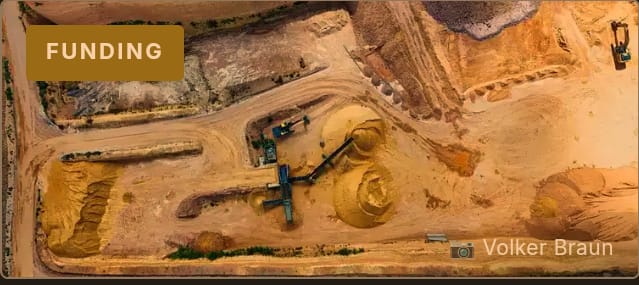
The United States International Development Finance Corporation (DFC) has committed $62.8 million to four rare-earth projects across Africa, as Washington steps up efforts to build critical-mineral supply chains less dependent on China.
The investments span Malawi, Angola, Madagascar and South Africa, with none of the projects having reached commercial production. The funding reflects growing US interest in Africa’s mineral resources amid intensifying global competition for critical minerals.
The largest share, about $50 million, has been allocated to the Phalaborwa rare-earth project in South Africa, backed by Dublin-based mining investor TechMet. The remaining $12.8 million is being distributed among projects in Malawi, Angola and Madagascar, although the DFC has not disclosed the individual amounts.
The move comes against a difficult investment backdrop. According to two senior DFC executives cited by Reuters, private capital has been slow to enter Africa’s rare-earth sector, leaving government-backed financing to shoulder some of the early risks involved in developing the projects.
The DFC said its objective is to help projects reach a less risky stage where they can attract private-sector investors. The approach highlights the challenges facing African developers seeking to turn promising mineral deposits into commercially viable operations.
Rare-earth projects typically require substantial upfront investment and reliable infrastructure, while developers also face uncertainty over future mineral prices. These challenges are particularly significant in African markets where processing facilities, transport networks and other mining infrastructure may be limited.
Industry experts have also warned that the number of proposed rare-earth projects could exceed future demand for some minerals. Neodymium-praseodymium, or NdPr, is particularly important because it is used in permanent magnets found in electric vehicle motors and wind turbines.
China’s dominance adds another layer to the competition. Beijing controls a major share of global rare-earth processing and has tightened export controls in recent years, raising concerns in Washington and other Western capitals over the security of critical-mineral supplies.
China’s influence extends beyond rare earths. Chinese state-backed financial institutions, including the China Development Bank and Export-Import Bank of China, have supported mining projects across Africa involving copper, cobalt, lithium and other strategic commodities.
The DFC’s strategy differs from China’s state-backed investment model. Rather than seeking to secure mineral supplies through large commercial agreements, the US agency is using public financing to reduce early-stage risks and encourage private investors to enter later.
The approach is not unique to Washington. European and British development finance institutions, including the European Investment Bank and British International Investment, have also increased support for African mineral projects as competition for resources linked to the clean-energy transition intensifies.
Africa already represents a significant part of the DFC’s global investment portfolio, accounting for between 20 and 25 per cent of its total investments. The latest rare-earth commitments therefore form part of a broader US strategy to deepen economic and strategic engagement with the continent.
For African governments, the financing provides an opportunity to advance mineral projects that might otherwise struggle to secure early-stage funding. However, the DFC’s involvement is designed as a bridge rather than a permanent source of capital.
The projects will ultimately have to attract commercial debt and private equity to reach full scale. Their success will depend on factors including geological certainty, permitting, infrastructure, processing economics and sustained demand for NdPr and other rare-earth minerals.
The $62.8 million commitment is therefore significant beyond its financial value. It signals Washington’s willingness to absorb some of the risks holding back Africa’s rare-earth sector and could help unlock a new wave of private investment if the projects demonstrate commercial viability.