WASHINGTON — A former senior adviser to Donald Trump’s first administration, Elliott Abrams, has sharply criticised the president’s new oil arrangement with Venezuela, describing it as a “shameful sellout” that could strengthen the grip of the country’s interim leadership while weakening Washington’s commitment to democratic transition.
Abrams, who previously served as Trump’s special representative for Venezuela, said the opportunity to restore democracy following the ousting of Nicolás Maduro was being squandered or delayed, arguing that the United States was no longer applying the strong pro-democracy policy it pursued during Trump’s first term.
The controversial oil arrangement gives North American Blue Energy Partners (NABEP), a company run by Venezuelan businessman Alejandro Betancourt, 100-year rights to 17 Venezuelan oil fields reportedly containing about 65 billion barrels of reserves. Under the agreement, the US State Department would have the right to purchase 20 per cent of NABEP’s output at production cost, while the US Department of War would hold a 35 per cent equity stake in NABEP’s parent company.
Abrams questioned the choice of Betancourt as a major US business partner, pointing to allegations and investigations surrounding his activities. He said Betancourt had long been associated with the business networks that prospered under the Chávez and Maduro governments and argued that his involvement could undermine Washington’s claims of promoting clean government and free enterprise.
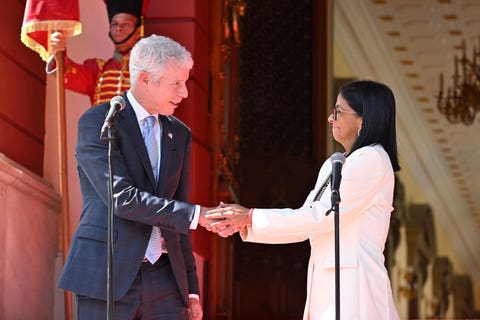
The former adviser also warned that the agreement could create a political incentive for Washington to keep interim President Delcy Rodríguez in power because, in his assessment, the oil arrangement is closely tied to her administration.
Writer’s perspective: This is where the Venezuela deal becomes bigger than oil. If Washington’s economic interests become intertwined with the survival of a political leadership whose democratic legitimacy remains contested, the United States risks creating a contradiction between its commercial objectives and its stated support for democratic government.
Abrams said Trump appears more personally engaged in Venezuela today than during his first administration, but argued that the focus has shifted from political transformation to stability and energy interests. He contrasted the current approach with the administration’s earlier backing of opposition leader Juan Guaidó and its efforts to remove Maduro.
He also questioned the role of Secretary of State Marco Rubio, who was previously a prominent congressional critic of the Venezuelan government. Abrams suggested that Rubio, despite his earlier advocacy for democracy in Venezuela and elsewhere in Latin America, is now operating within the political constraints imposed by the president.
The former adviser maintained that the oil agreement could damage US credibility throughout Latin America by creating the impression that Washington’s earlier appeals for freedom and democracy were secondary to securing access to Venezuela’s vast oil resources.
Writer’s perspective: The geopolitical consequences could extend beyond Venezuela. Latin American governments are watching how Washington exercises its power, while China and Russia continue seeking deeper economic and diplomatic relationships in the region. If US policy is perceived as prioritising resources over democratic principles, Washington could lose some of the soft power it has spent decades cultivating.
Abrams further argued that the agreement may face serious political and legal obstacles inside Venezuela, claiming that the country’s constitution restricts the transfer of national resources and requires legislative approval for major arrangements involving national patrimony.
He predicted that major international oil companies could remain cautious about committing substantial long-term capital because the political future of Venezuela remains uncertain. Investors, he argued, cannot be certain that a future democratically elected government would recognise an agreement negotiated under the current leadership.
The opposition, according to Abrams, is also likely to challenge the arrangement. He said political forces across Venezuela’s ideological spectrum have reasons to oppose the deal and suggested that a future elected government could attempt to overturn it.
Abrams said Washington should instead make a 2027 presidential election a central condition of its engagement with Caracas, alongside the release of political prisoners and the return of Venezuelan exiles, arguing that these measures would provide a credible pathway towards democratic restoration.
He also called for negotiations with Venezuela’s military establishment, arguing that a successful transition would require assurances that the armed forces have a legitimate role in a democratic state rather than being collectively punished for their role under previous governments.
However, The fundamental test for Washington is whether the Venezuela policy can simultaneously deliver energy and economic gains while preserving a credible democratic transition. Oil investment may help revive a devastated economy, but if access to Venezuela’s resources comes at the price of political accountability, the arrangement could ultimately strengthen the very political system Washington once sought to dismantle.
The controversy therefore raises a larger question about the future of US foreign policy: is Venezuela being rebuilt as a democratic state with an oil industry, or is its oil industry becoming the foundation of a new political bargain? For Abrams, the answer is increasingly clear — Washington must demonstrate that its interest in Venezuelan oil does not outweigh its commitment to Venezuelan democracy. Hi