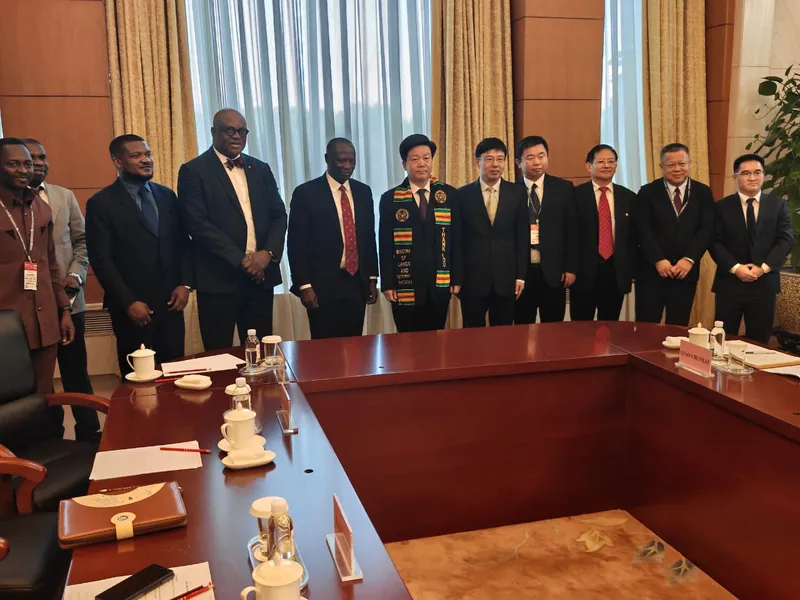
Ghana and China have agreed to strengthen oversight of Chinese mining companies operating in Ghana and deepen geological cooperation as Accra intensifies its campaign against illegal gold mining, popularly known as galamsey.
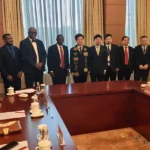
The agreement, reached during a meeting between Ghana’s Ministry of Lands and Natural Resources and China’s Ministry of Natural Resources on the sidelines of the 2026 China Mining Conference in Tianjin, reflects a growing recognition that Ghana’s mineral wealth must be protected through stronger regulation, responsible investment and technological advancement.
The three-point strategy focuses on tackling illegal mining, expanding cooperation in geological surveys and mapping, and attracting responsible Chinese investment into Ghana’s mining sector.
For Ghana, the significance of the agreement lies not merely in its diplomatic value but in whether it can translate into effective enforcement. Years of illegal mining have polluted rivers, degraded forest reserves and raised serious questions about the government’s ability to protect the country’s natural resources.
Ghana’s Minister of Lands and Natural Resources, Emmanuel Armah-Kofi Buah, said the cooperation would create a mechanism for holding Chinese companies and nationals operating in Ghana to higher standards.
“This is very important in how we collaborate on critical areas of the natural resources sector. This includes how to work with them in policing Chinese companies that are working in Ghana to make sure that they meet the highest standards,” Buah said.
He added that Chinese nationals found to have violated Ghanaian mining laws could face sanctions in both countries.
“Those who are found to have broken the law, especially those who engage in illegal mining activities, are not only punished in Ghana, but we have a pathway where the Chinese will also police their people who are working in Ghana,” he said.
The proposed cooperation comes amid mounting environmental damage and growing public frustration over the persistence of illegal mining. In August, Buah disclosed that 258 suspects had been arrested during operations against illegal mining in forest reserves, while the government estimated that approximately 8,900 hectares of forest reserves had been completely degraded.
The National Anti-Illegal Mining Operations Secretariat also broadened its Operation WATER SHIELD campaign in September to target financiers, facilitators, logistics networks and equipment suppliers supporting illegal mining around rivers and watersheds.
However, arrests alone will not resolve Ghana’s galamsey crisis. The government’s ability to secure successful prosecutions, recover degraded land and prevent the return of illegal operators will ultimately determine whether the campaign produces lasting results.
According to report, China’s Deputy Minister of Natural Resources, Sun Shuxian, proposed expanded cooperation in geological surveys, mineral mapping, technological innovation and assessments of Ghana’s critical-mineral potential.
The technical proposals include satellite remote sensing, airborne geophysical surveys, joint laboratories, annual exchanges of technicians and joint field training. Such support could help Ghana improve its geological data, identify mineral deposits more accurately and strengthen the capacity of its Geological Survey Authority.
Buah also used the conference to seek Chinese investment in domestic mineral processing, technology transfer and mining infrastructure. The objective is to enable Ghana to capture more value from its mineral resources instead of depending largely on the export of raw materials.
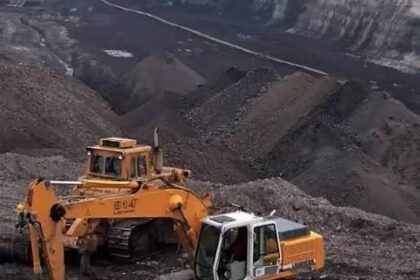
Chinese companies already have a substantial presence in Ghana’s gold industry. Zijin Mining operates the Akyem mine, which it acquired from Newmont for $1 billion in 2025. Chifeng Gold owns the Wassa mine, while Shandong Gold controls the Cardinal Namdini operation.
This existing presence makes stronger oversight particularly important. Chinese investment can provide capital, technology and employment, but its long-term value to Ghana will depend on compliance with environmental regulations, transparency in operations and meaningful benefits to local communities.
Ghana is also seeking to attract investment into lithium and other critical minerals as it attempts to diversify its mining industry. Yet the success of these ambitions will depend on the government’s ability to demonstrate that its mineral resources can be developed without sacrificing forests, waterways and the livelihoods of affected communities.
The Ghana-China agreement therefore presents both an opportunity and a test. Greater technical cooperation and investment could strengthen Ghana’s mining industry, but only firm enforcement, transparent accountability and sustained environmental protection will determine whether the partnership delivers meaningful results.
Can Ghana attract mining investment is less of a question but whether it can ensure that the wealth beneath its soil does not come at the expense of the country’s future.