This week, in a Washington courtroom, the President of Nigeria is arguing that his past belongs to him
There is a filing sitting in the United States District Court for the District of Columbia, dated August 28, 2026, running to sixteen pages. It was submitted on behalf of Bola Ahmed Tinubu, President of the Federal Republic of Nigeria. Its purpose is to persuade an American judge that records held by the FBI and the Drug Enforcement Administration concerning him should remain blacked out.
The argument his lawyers make is worth reading slowly, because it tells Nigerians something no campaign speech ever will. They argue that the Freedom of Information Act exists to illuminate what governments do, not to expose private information about individuals held in government files. They invoke Exemption 7(C), which shields personal privacy in law enforcement records. In plain English: the President of Nigeria is asking a foreign court to recognise that he, personally, has a right to privacy in a criminal investigative file.
Aaron Greenspan, the American transparency activist who filed the underlying request, had until September 11 to oppose. The FBI, the DEA and Tinubu’s legal team have until September 18 to respond. This editorial is published in the gap between those two dates. Somewhere in Washington this week, lawyers paid to protect a Nigerian president’s reputation are drafting the argument for why 230 million Nigerians should not see what their own head of state’s file contains.
What is in the file, precisely
Let us be exact, because precision is the only thing that makes this newspaper worth reading on a subject this contested.
On July 26, 1993, the United States government filed a civil forfeiture action, case number 93 C 4483, in the Northern District of Illinois. It rested on an affidavit from Internal Revenue Service Special Agent Kevin Moss, who alleged that money held in accounts at First Heritage Bank and Citibank was traceable to a Chicago heroin network that had operated between roughly 1988 and 1991, run by Adegboyega Mueez Akande and his nephew Abiodun Agbele. In January 1992, American authorities had frozen more than $1.4 million linked to Tinubu, arguing the sums did not match his declared legitimate income at the time.
Tinubu contested it. He argued the money belonged legitimately to himself, to his wife Oluremi, and to Alhaja Abibatu Mogaji — described in the proceedings as his foster mother. The case never went to trial. A settlement was reached, and on October 4, 1993, Judge John A. Nordberg ordered $460,000 in First Heritage account number 263226700 forfeited to the United States government as proceeds of narcotics trafficking or funds involved in money laundering, under 21 U.S.C. § 881(a)(6) and 18 U.S.C. § 981. The balance, over a million dollars, went back to the family.
Now the part that Tinubu’s critics consistently skip, and that this newspaper will not: **a civil forfeiture is not a criminal conviction.** It is an action against property, not a person. Bola Tinubu was never criminally charged in the United States. He has always denied wrongdoing. Any Nigerian who tells you a court convicted him of drug trafficking is lying to you, and lying badly, because the actual record is damaging enough without embellishment.
But here is the question the distinction does not answer, and it is the only question that matters now: if the file exonerates him, why is he paying American lawyers to keep it closed?
In April 2025, Judge Beryl Howell ruled that the FBI and DEA had failed to justify refusing even to confirm the investigation existed, and ordered them to search and process records. In February this year, she publicly lambasted both agencies for delay tactics and imposed deadlines. The agencies have since released around 399 pages, heavily redacted. The FBI has asked to explain its redactions to the judge secretly, in camera and ex parte, claiming disclosure could endanger someone’s life. Greenspan opposes. And the President of Nigeria has intervened personally to support the blackouts.
Men who have been cleared do not litigate for three years to keep the clearance sealed.
The certificate: what was actually said, under oath
On October 3, 2023, Chicago State University registrar Caleb Westberg gave a deposition ordered by Judge Nancy Maldonado. What he said was more complicated than either Nigerian camp has ever admitted.
Westberg confirmed, repeatedly and under oath, that Bola Tinubu attended CSU and graduated in 1979. He said the university believed the Tinubu who studied there is the same man who is President of Nigeria. He also said, in the same deposition, that the diploma Tinubu submitted to INEC on June 17, 2022 did not come from the university, that CSU could not authenticate it, and that Tinubu neither applied for nor received a replacement certificate. Earlier, in a July 2023 affidavit in Cook County, the same registrar had attested that Tinubu graduated and was awarded a degree. Tinubu’s own lawyers attributed the visible discrepancies — a wrong graduation date, a changed logo, a different font — to a clerk’s error at CSU.
Both camps then did what Nigerian politics always does. The presidency’s Dada Olusegun argued a man cannot forge what he already possesses. Atiku’s camp declared forgery proven. Neither was reading the document honestly.
Then came the moment that should trouble every Nigerian regardless of party. In October 2023, the Supreme Court refused to look at any of it. Justice Inyang Okoro held that the 180-day constitutional window for election petitions was immutable, that forgery had not been pleaded at the tribunal, and that fresh evidence could not be introduced on appeal. The application was refused and dismissed.
Read that again. **Nigeria’s highest court never ruled that the certificate was genuine. It ruled that it was too late to ask.** The most serious documentary question ever raised about a Nigerian president was not answered. It was timed out. And a political establishment has spent three years since treating a procedural deadline as though it were a verdict of innocence.
The blank space where a childhood should be
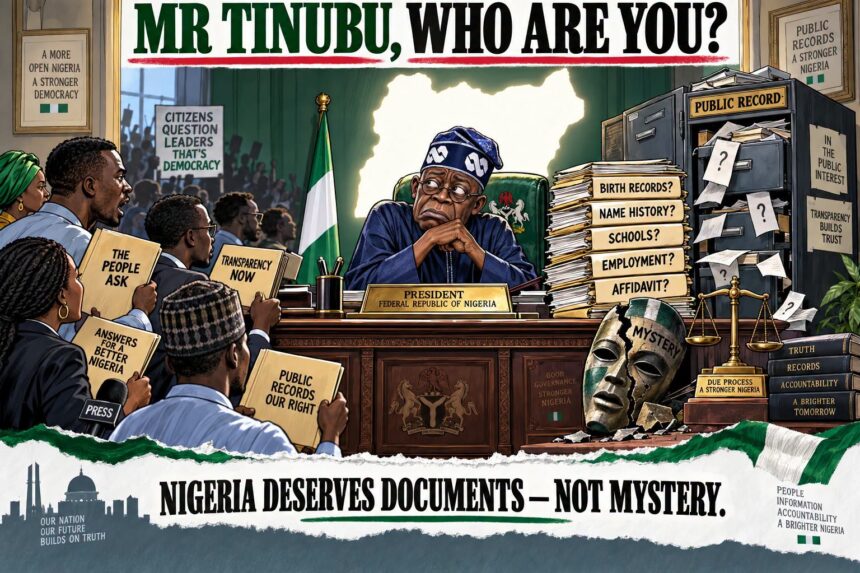
On August 1, 2026, INEC published Tinubu’s nomination papers for the 2027 election. Under “Schools Attended/Educational Qualifications with Dates,” there is one entry: a Bachelor of Science from Chicago State University. No primary school. No secondary school. Nothing before Chicago.
Constitutionally, he is entitled to that silence. Section 131 requires a School Certificate or equivalent, and nothing in the Constitution compels a candidate to list where he learned to read. Anyone claiming this disqualifies him is wrong.
But consider what surrounds the blank. In 1999, contesting for Lagos governor, his INEC form claimed Government College Ibadan and the University of Chicago. Neither was true — he attended Chicago State, a historically Black university, not the private University of Chicago, and Government College Ibadan has no record of him. His camp said the form was filled in error by someone else. His own former press secretary, Segun Ayobolu, later offered a different explanation entirely: that Tinubu had not attended secondary school at all, because of poverty.
Meanwhile, the CSU records released in 2023 carry a birth date of March 29, 1954 on one document and March 29, 1955 on the undergraduate application, against the March 29, 1952 he has sworn to INEC for decades. One CSU record marks the student’s gender as female; Westberg testified the admission letter showed male.
The story he refuses to tell is the one that would save him
Here is what makes this genuinely painful rather than merely scandalous.
If Segun Ayobolu was right — if a boy in Lagos in the 1960s was too poor to finish school, was taken in and raised by Abibatu Mogaji, scraped his way to a community college in Chicago and then to a degree, and came home to become Governor of Lagos and then President — that is not a disgrace. That is the single most powerful biography any Nigerian politician could possess. It is the story millions of Nigerians are living right now: the market woman’s foster son who made it. Bill Clinton was born William Blythe. JD Vance was born James Bowman. Neither man’s rise was diminished by the names he shed or the family that took him in. Adoption is not shame. Poverty is not shame.
What is shame is this: a man who could have told that story, and did not. Who instead put “Government College Ibadan” on a government form. Who left the box blank in 2026. Who hired lawyers in Chicago, lawyers in Abuja, and now lawyers in Washington — and who this very week is asking a foreign judge to accept that a sitting president’s investigative file is his own private business.
Nigerians are not owed perfection. They are owed the documents. Publish the complete CSU application file and the primary and secondary school records, or say plainly that there are none and explain why. Withdraw the objection in Greenspan v. Executive Office for U.S. Attorneys and let the 7(C) redactions fall. Release, voluntarily, the full 1993 case file that American agencies have spent three years redacting on his behalf.
If the file is clean, none of that costs him a single vote. If it is not, then Nigerians have been governed for three years by a biography no one was permitted to check — and they will find out in a Washington courtroom rather than from the man they elected.
The presidency is not a hiding place. It is not a vault, and it is certainly not a privacy right. Mr President: the question is not going away, and on September 18, you will answer it either to a judge or to us.
—
*This is a United Continental Post editorial. It draws on U.S. District Court records in Greenspan v. Executive Office for U.S. Attorneys (Civil Action No. 23-1816, D.D.C.) and United States v. funds held in account 263226700 (No. 93 C 4483, N.D. Ill.); the October 3, 2023 deposition of CSU registrar Caleb Westberg; the Supreme Court of Nigeria’s October 26, 2023 judgment; INEC’s published 2027 nomination papers; and reporting by Daily Trust, The Punch, TheCable, Premium Times, Sahara Reporters, Peoples Gazette, FIJ and The Daily Beast. President Tinubu has never been criminally charged in the United States and denies wrongdoing. UCP found no evidence supporting claims circulating online regarding the President’s biological parentage or an alleged change of name, and does not publish them.*