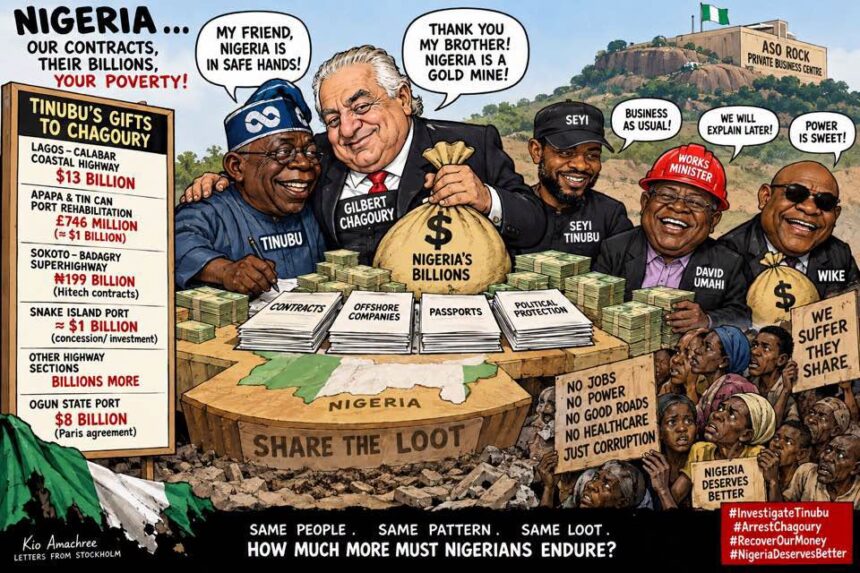
The contracts, the conflicts of interest, and the questions the Presidency has still not answered.
For months, almost every week, I have written about Gilbert Chagoury: the Lebanese-Nigerian businessman with a Swiss money-laundering conviction linked to the Abacha regime, and the hold his companies now have on some of the largest public contracts in Nigerian history. Nigerians have done very little about it. So I will say it again, with the numbers, and with a clear line between what is documented and what is not.
The pattern is simple. A Chagoury company, Hitech Construction, was given the Lagos–Calabar Coastal Highway without an open public tender. The President’s son has documented business connections with the same family. Other Chagoury-linked companies have since turned up in ports and highways worth billions more. How can any reasonable Nigerian look at that arrangement and not demand an investigation?
The conflict of interest
In August 2024, the Organised Crime and Corruption Reporting Project reported, from documents leaked to the International Consortium of Investigative Journalists, that Seyi Tinubu was a majority shareholder in a British Virgin Islands company alongside Ronald Chagoury Jr., the son of Gilbert Chagoury’s brother. The company had been incorporated about eight years earlier. Its current ownership was unclear, and neither man commented. Separately, the Presidency has confirmed that Seyi Tinubu sits on the board of CDK Integrated Industries, a Hitech subsidiary, and has dismissed it as irrelevant because CDK makes tiles.
It is not irrelevant. A sitting president’s son holds a board seat inside the same corporate group that keeps winning his father’s government’s biggest awards. No one has to allege that he poured concrete on the highway. The question is what safeguards exist, and the answer so far is the Presidency’s word.
The contracts and the money
I want to be careful here, because the figures are easy to inflate. An estimate is not a payment, and a section is not a whole road.
- Lagos–Calabar Coastal Highway. The roughly 700-kilometre road was estimated at $11 billion to $13 billion when Bloomberg reported on it in May 2024. Atiku Abubakar put it at ₦15.7 trillion. The government has never published a total. What has been disclosed is smaller: ₦1.067 trillion for the first 47-kilometre section, a $747 million syndicated loan arranged by Deutsche Bank for that section in July 2025, $1.26 billion in financing announced for the second section in December 2025, and, by the Works Minister’s account, contracts above ₦3 trillion for sections in Lagos, Akwa Ibom and Cross River. Hitech was chosen through what David Umahi calls restrictive bidding, not an open tender. None of this means $13 billion has been paid.
- Apapa and Tin Can ports. On March 19, in London, Nigeria signed a £746 million export-finance agreement, about $1 billion, guaranteed by UK Export Finance and coordinated by Citibank. The Nigerian Ports Authority and the Finance Ministry are parties to it. THISDAY reported that Hitech and ITB Nigeria, both Chagoury companies, would carry out the refurbishment, and Africa Intelligence had earlier reported that the contract went to ITB. The terms were not immediately disclosed. This is financing Nigeria is party to, not a gift.
- Sokoto–Badagry Superhighway. In early July, the Federal Executive Council approved about ₦1.7 trillion, roughly $1.24 billion, for a section of the road in Kebbi State, awarded to Hitech, together with a separate $1.2 billion financing facility for that section. In April, the House of Representatives had already approved a $516 million loan for the highway. The superhighway runs for more than 1,000 kilometres. The figure for Hitech’s section must not be confused with the cost of the whole road, and Nigerians still need the full breakdown of what has been awarded to Hitech and at what price.
- Snake Island Port. In March, MSC announced a 45-year terminal agreement at Snake Island in which ITB Nigeria is a construction partner alongside DEME, and said its wider Nigerian investment exceeds $1 billion. This is a private concession and should not be described as a federal cash contract to Chagoury. But the ownership structure, investment commitments and any federal role should be disclosed.
- Eko Atlantic. This multibillion-dollar development on reclaimed land long predates Tinubu’s presidency, and it is not a presidential contract. It matters because it shows how old the relationship between the Chagoury Group and the Lagos political establishment is. In 2007, Tinubu’s Lagos administration granted the group title to ten million square metres of shoreline.
And these are only the arrangements I can identify publicly. How many billions more sit in agreements Nigerians have never seen?
The deals signed abroad
On September 24, Tinubu witnessed the signing in Paris of agreements worth more than $7 billion for the Ogun Gateway Deep Sea Port and the Blue Marine Special Economic Zone. The publicly identified partner was DP World, not Chagoury, and these are proposed investments, not money Nigeria has paid out. But BusinessDay and THISDAY, citing Africa Intelligence, have reported that Chagoury arranged a February 2025 meeting between Tinubu, the Marine Minister and DP World’s then-chief executive, Sultan Ahmed bin Sulayem, who resigned a year later over his documented correspondence with Jeffrey Epstein. I want every agreement signed abroad in Nigeria’s name examined: the ownership structures, the public guarantees and the political connections.
I am tired of presidents flying to foreign capitals to announce billions while Nigerians are told nothing of the obligations being created in their names.
The record
In 2000, a Geneva court convicted Gilbert Chagoury of money laundering and aiding a criminal organisation over funds linked to the Abacha regime. He was fined one million Swiss francs and undertook to return $66 million to Nigeria. He has said he did not know the money was stolen, and the conviction has reportedly been expunged. In 2021, the US Justice Department announced that he had paid $1.8 million to resolve an investigation into illegal foreign contributions of roughly $180,000 to four federal candidates.
I have seen other allegations about him. They are not evidence, and I will not repeat them here. The documented history alone is enough to demand the strictest scrutiny of his dealings with public officials. What exactly must a businessman do before Nigerian authorities start asking serious questions?
The citizenship question
Gilbert Chagoury was born in Lagos in 1946 to Lebanese parents. Being born on Nigerian soil does not by itself make anyone a citizen by birth; the Constitution requires a parent or grandparent from a community indigenous to Nigeria. Section 28 then provides that a person who is not a citizen by birth forfeits Nigerian citizenship if he acquires or retains another nationality. He is publicly recorded as having served as Saint Lucia’s ambassador to the Holy See and its delegate to UNESCO, and one profile credits him with British and Lebanese citizenship as well.
I do not know how or when he came to hold Nigerian citizenship, and I have found no reliable public account of it. That is exactly why I petitioned the Director-General of the Nigerian Immigration Service to establish which nationality he holds by birth, which he acquired later, and whether his Nigerian status complies with the Constitution. My petition was ignored. Why? Does a relationship with powerful politicians now place a businessman beyond the reach of the immigration laws?
London and Paris
I also spent about two hours briefing Britain’s Serious Fraud Office on my concerns. As far as I was told, nothing came of it.
I will not claim to know why. But the question is not far-fetched. The £746 million port financing is guaranteed by the British government, with at least £236 million earmarked for British suppliers, including a £70 million steel order that goes to Hitech and ITB. Britain lectures Nigeria about corruption while its taxpayers underwrite the very contracts under suspicion. Is business now more important than accountability?
France raises similar questions. Nigerian investigative reporting has documented that Chagoury hosted Tinubu in Paris in July 2022, and since taking office the President has spent more than fifty days in France across twelve trips, according to government travel-spending records reported by Pulse Nigeria. The Ogun agreements were signed in Paris. Nobody has explained to the public what, if anything, ties these facts together, and Nigerians deserve to know.
For raising these issues, I have been threatened with a lawsuit, attacked in the Nigerian press, called a racist, and threatened in other ways. I told them to sue me. I would welcome the chance to place the evidence before a court and seek disclosure of the documents. I am not interested in Mr Chagoury’s race. I am interested in his conduct, his contracts, his political connections and the money.
The Works Minister and the road that keeps changing
I have warned from the start that the Lagos–Calabar highway was surrounded by unanswered questions about cost, procurement and the relationship between the President and the contractor. Now the government is explaining changes to the project. In December 2024, David Umahi announced that sections would be cut from ten lanes to six at a lower cost. On October 12, he said the road beyond the Ondo boundary will follow the existing East-West Road, and that about ₦170 billion in extra costs on the Lagos section is a risk Hitech must carry. No revised cost for the new route has been published.
Umahi insists the original project has not been cancelled. Very well. Where are the original contracts? Where are the revised ones? Where are the payment records and the engineering assessments? How much has been spent, and how much remains to be spent? And why was a project of this size awarded without an open public tender?
I am not saying the entire $13 billion has disappeared. The available evidence does not establish that. I am saying Nigerians are entitled to a full forensic accounting of every dollar and naira committed to this project, independently verified. I fear the country will be left with unfinished roads, large debts and disputed contracts, while the contractors have already protected their own commercial interests.
What the government says
The government’s position deserves a fair statement. Umahi says the procurement followed due process, that restrictive bidding is a lawful method, and that the President did not recommend Hitech. He cites Hitech’s record on the Apapa–Oshodi Expressway and its equipment and manpower. The Presidency says Seyi Tinubu’s role at CDK has nothing to do with highway awards. Chagoury says he did not know the funds in the Geneva case were stolen.
None of that answers the question. Competence is a reason to bid. It is not a reason to skip open bidding, again and again, for companies tied to the President’s friend and, in part, to his son.
What I am asking for
I am calling for an independent investigation into these awards and the relationships behind them, including those of the President, his son, the Works Minister and Gilbert Chagoury himself. Where credible evidence establishes a crime, I want prosecutions. Until then, I want:
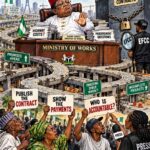
PUBLISH THE CONTRACTS, THE BIDS AND THE TECHNICAL EVALUATIONS. FOLLOW THE MONEY, FROM EVERY LOAN TO EVERY PAYMENT CERTIFICATE. DISCLOSE THE OWNERSHIP OF EVERY OFFSHORE COMPANY TIED TO THESE AWARDS. SETTLE, IN PUBLIC, WHAT CITIZENSHIP GILBERT CHAGOURY HOLDS AND HOW HE ACQUIRED IT. AUDIT EVERY MULTIBILLION-DOLLAR AWARD TO THIS NETWORK BEFORE MORE PUBLIC MONEY IS COMMITTED.
The EFCC, the ICPC and the National Assembly should stop acting as though politically connected billionaires and senior officials are untouchable. If our institutions cannot examine a president’s friends, his family’s business ties and his ministers’ contracts, Nigerians are entitled to ask whether the system is capable of protecting the republic at all.
Nigeria is not the private property of any president, any family or any wealthy friend. I warned you. The documents are the next step.
This is a United Continental Post column. It draws on reporting by OCCRP, Bloomberg, BusinessDay, THISDAY, Premium Times, TheCable, Arise News, Sahara Reporters, Leadership, Tribune, allAfrica, Nairametrics, Pulse Nigeria, The Whistler and Within Nigeria; Swiss and US court records as reported by the Council on Foreign Relations and the US Department of Justice; and statements by Works Minister David Umahi and Presidency spokesman Bayo Onanuga. The author’s accounts of his petition to the Nigerian Immigration Service, his briefing of the UK Serious Fraud Office, the threats he reports receiving, and the legal threat against him are his own and have not been independently verified by UCP. Gilbert Chagoury has said he did not know the funds in the 2000 Swiss proceedings were stolen. No court has found wrongdoing in the awards discussed.