The Federal Government’s push to make transportation cheaper through Compressed Natural Gas is entering a decisive stage, with President Bola Ahmed Tinubu asking state governments to ensure that the benefits of cheaper energy are passed on to commuters from October 1.
The objective is understandable: reduce the cost of operating commercial vehicles, bring down transport fares and cushion Nigerians from the continuing pressure of high petrol and diesel prices. But the bigger question is whether Nigeria’s CNG infrastructure and gas market are sufficiently mature to make that promise nationwide.
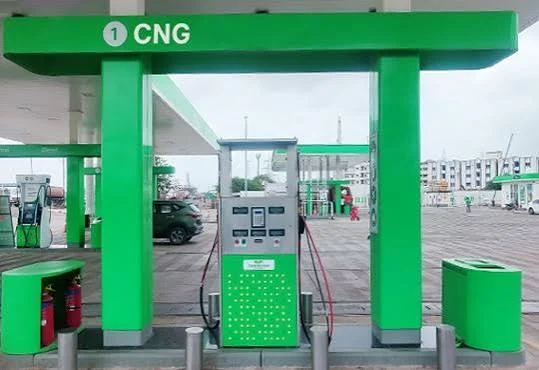
The CNG initiative has undoubtedly recorded progress as the Presidential Initiative on CNG and Electric Vehicles says Nigeria now has more than 400 certified conversion centres, over 90 refuelling stations, more than 7,700 trained technicians and more than 120,000 converted vehicles yet the numbers also expose the central problem: a country of more than 200 million people and a vast commercial transport network is still relying on a relatively small refuelling infrastructure, with the official station directory listing facilities in only 23 states.
That gap becomes more obvious when the experience of transport operators is examined. In Lagos and other locations, motorists have reported spending hours waiting to refuel. For a commercial driver, time spent in a queue is not merely an inconvenience; it is lost working time, lost trips and lost income. If a driver who should complete several journeys in a day spends hours waiting for CNG, the saving at the pump can easily be diluted by the economic cost of the delay.
This raises a fundamental question: can Nigeria reduce transport fares simply by changing the fuel in vehicles without first guaranteeing that the fuel will be consistently available?
The Federal Government has argued that the CNG transition will eventually solve this problem as more stations and conversion centres are built. The official programme says the country has more than 90 refuelling stations and more than 400 certified conversion centres, while the government has also supported major infrastructure projects through the Midstream and Downstream Gas Infrastructure Fund.
But “eventually” is the important word. October 1 is not an eventual date. It is a specific deadline. The difference between having infrastructure under development and having infrastructure that a commercial driver can depend on every day could determine whether the policy succeeds at the commuter level.
There is also the question of conversion costs. Operators interviewed in different parts of the country put the cost of conversion at hundreds of thousands of naira, with some citing figures approaching N1m depending on the vehicle and cylinder configuration. Government-backed financing is available, and the Presidential Initiative says financing structures have been developed to make conversion more accessible. But accessibility on paper is different from affordability for a driver whose daily income is already being consumed by fuel, food, maintenance, levies and household expenses.
More importantly, who will repair these vehicles when they develop faults?
The government says thousands of technicians have been trained, with the Pi-CNG programme reporting more than 7,700 trained technicians nationwide. That is encouraging, but Nigeria needs to move beyond the number of people trained to the availability of competent technicians where the vehicles actually operate. A CNG vehicle travelling from Lagos to Kano, Port Harcourt to Abuja or Maiduguri to another state needs dependable technical support along the route, not merely a certified workshop somewhere in the country.
This is one of the areas where the CNG policy deserves more scrutiny. The conventional Nigerian mechanic may be able to diagnose and repair petrol- or diesel-powered vehicles, but CNG introduces additional components, cylinders, valves, regulators and fuel-system considerations. The existence of trained technicians is therefore important, but the real test is whether commercial drivers can quickly find properly certified technicians who can safely diagnose and repair CNG systems when faults occur.
Safety is another issue that cannot be treated as propaganda for or against CNG. CNG can be used safely when vehicles are properly converted and maintained, but the danger of substandard installations is real. Indeed, the Presidential Initiative issued a warning on September 14 after an Abuja incident involving an unauthorised cylinder that it said was not designed or certified for automotive CNG use. The agency stressed that only approved automotive CNG cylinders and certified components should be used.
The incident should therefore reinforce a simple principle: the cheaper the conversion, the more important regulation becomes. If struggling vehicle owners begin patronising roadside or unqualified technicians because certified conversion is considered too expensive, the government could create a safety problem while attempting to solve an economic one.
Then comes the most uncomfortable question: what happens if gas itself becomes significantly more expensive?
It is important not to confuse LPG, used mainly for cooking, with CNG, used as vehicle fuel. Nigeria does not have a comparable retail CNG price history from 2018 because the present nationwide CNG transport programme only emerged in 2023. However, the broader history of gas prices provides a warning. Cooking-gas prices, for example, were around N600 per kilogram in 2018, had risen above N1,000 by 2023, reached about N1,400 in 2025 and were reported above N2,000 in 2026, although LPG and CNG are different products and markets.
The more directly relevant benchmark is Nigeria’s regulated domestic natural-gas pricing. The benchmark was about $2.18 per MMBtu in 2021, rose to $2.42 in 2024, was revised down to $2.13 in 2025 and increased again to $2.18 from April 2026. Commercial gas was also priced higher than the strategic power-sector benchmark.
This does not mean that CNG must become unaffordable. In fact, industry discussions have cited a concessionary CNG price of $1.57/MMBtu for five years as part of the policy framework. But it demonstrates why the government cannot assume that the word “gas” automatically means permanently cheap energy. Gas has a market, a supply chain, transportation costs and infrastructure costs.
And that leads to perhaps the biggest philosophical question surrounding the policy: is government introducing CNG because it believes petrol and diesel prices will remain structurally high?
The answer appears, at least partly, to be yes. The decision to diversify transport energy away from petrol and diesel reflects the reality that Nigerians can no longer rely on permanently cheap petroleum products. The removal of petrol subsidy fundamentally changed the economics of transportation, while global crude prices and exchange-rate movements continue to influence petroleum-product costs. As of September 2026, petrol prices in Lagos and Abuja have reached roughly N1,400 per litre, while diesel has moved above N2,000 per litre amid higher global oil prices.
In that sense, CNG is not simply a temporary response to an expensive petrol market. It looks like an attempt to change the energy structure of Nigerian transportation.
But changing the energy structure requires more than changing vehicle fuel tanks.
The experiences of the states illustrate the distinction. Kaduna says its free CNG bus service has been operating since 2025, while Borno has combined CNG with electric transport. Plateau operates subsidised buses, and Rivers plans to return palliative buses to the roads. Such programmes can reduce fares because governments are directly absorbing part of the transportation cost. They should not automatically be interpreted as proof that private commercial transport can achieve the same fares without subsidies.
There is also a danger in setting an October 1 deadline without measuring the actual economics route by route. The cost of a commercial journey is not determined by fuel alone. Vehicle financing, spare parts, tyres, engine maintenance, insurance, licensing, union dues, road conditions, driver wages and downtime all contribute to the final fare.
Therefore, even if CNG reduces fuel expenditure by 40 or 50 per cent, transport fares will not necessarily fall by the same percentage. The government needs to publish transparent calculations showing the expected reduction in operating costs and how much of that reduction should reasonably be reflected in passenger fares.
The long queues reported at some stations present another economic contradiction. A driver may save money per kilogram of CNG but lose several hours waiting to obtain it. If more vehicles are converted before more stations become operational, the policy could unintentionally transfer the fuel queue from petrol stations to CNG stations.
Nigeria should therefore resist the temptation to measure the success of CNG by the number of vehicles converted alone. The more meaningful indicators are the number of functioning refuelling stations, average waiting time, geographic coverage, availability of gas, conversion cost, number of active certified technicians, repair turnaround time and the actual reduction in the cost of operating commercial vehicles.
There is reason for optimism because the government is investing in the infrastructure. The four CNG projects commissioned in Lagos, Abuja and Owerri in May are examples of the infrastructure needed to build a larger network. The Federal Government has also directed the accelerated deployment of mobile refuelling units while permanent facilities expand.
But optimism should not replace realism.
CNG can reduce transportation costs in Nigeria, but it cannot do so automatically, everywhere and immediately. The fuel must be available, the conversion must be affordable, the vehicle must be safely converted, technicians must be available to maintain it, stations must be numerous enough to prevent debilitating queues, and the underlying price of gas must remain competitive.
The October 1 target should therefore be viewed not merely as a deadline for announcing cheaper fares but as a test of whether Nigeria has built enough of the supporting ecosystem to sustain those fares. If governments simply order transporters to reduce fares while leaving operators to struggle with conversion costs, inadequate stations, maintenance expenses and long queues, the policy could produce temporary fare reductions that will eventually become unsustainable.
The real success of CNG will not be measured by how loudly government announces it, but by whether an ordinary Nigerian can board a bus, pay less, arrive on time and know that the driver can refuel and maintain that vehicle without losing an entire day.
Nigeria has abundant gas resources and a strong economic argument for using more of them domestically. But abundance underground is not the same as affordability at the roadside. The country must build the infrastructure, skills, financing and regulatory framework that connect the two.
CNG may well become an important part of Nigeria’s transport future. But if the country wants cheaper transportation rather than merely cheaper fuel, it must solve the entire transportation equation.