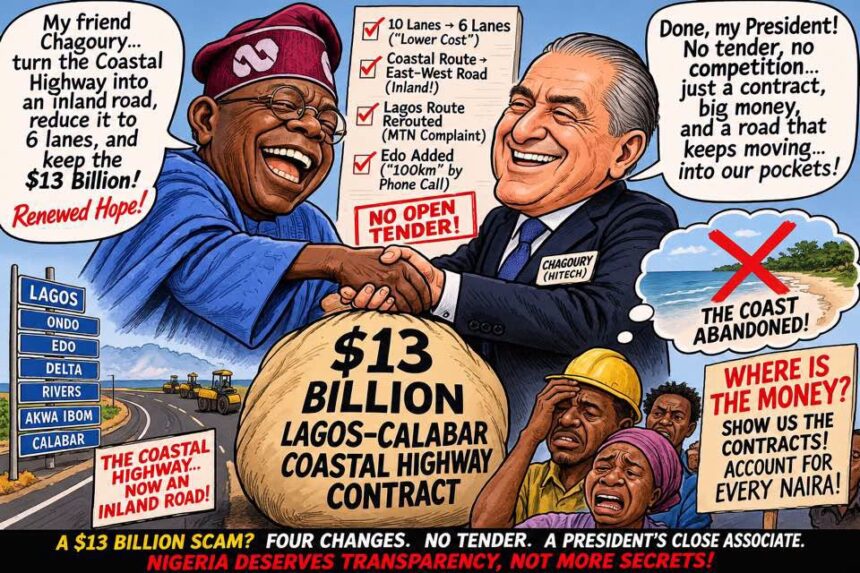
The coastal highway no longer follows the coast. The ten-lane road became six. The route has changed four times. None of it was put to open tender. Where is the money?
For months I have warned Nigerians about the financial relationship between Bola Tinubu and his longtime associate, Gilbert Chagoury. I have questioned the contracts. I have questioned the absence of open competitive bidding. I have questioned why a man with a documented money-laundering conviction connected to the Abacha regime sits at the centre of the most expensive infrastructure project in Nigeria’s history.
This week the government answered me, though not in the way it intended.
On October 12, Works Minister David Umahi confirmed that the Lagos–Calabar Coastal Highway will not be built as a new coastal road beyond Ondo. It will follow the existing East-West Road from the Ondo boundary into Edo, a corridor of about 104 kilometres that includes a 45-kilometre Benin bypass. The reason, he says, is difficult ground and the cost of building a new alignment.
The cost of building. On a project Bloomberg put at up to $13 billion in May 2024, and whose total the government has never published. The difficulty was discovered after the contract was signed, after the financing was raised, after houses were demolished and after construction began.
A coastal highway that does not follow the coast is a different project with the same name, the same contractor and, so far as the public has been told, the same price. Nobody has said otherwise, because nobody has been shown the numbers.
Four changes in 31 months
Nigerians are being asked to treat this as an engineering adjustment. It is the latest of at least four publicly announced changes since construction began in March 2024.
May 2024, Lagos. At a stakeholders’ meeting, Umahi announced that the road would abandon its new alignment between kilometres 16 and 25 and revert to the old gazetted route, rejoining the new alignment at kilometre 25. The reason was to protect the submarine cables of MTN and 2Africa, and a 50-megawatt power plant that supports them. The decision came after the road had been announced, the alignment published and construction started.
December 2024, lanes. Umahi announced that the project would be reviewed from ten lanes to six, at a lower cost, citing design variations and the removal and backfilling of refuse to a depth of 10 metres. A road cut by 40 per cent of its width should be cheaper. In October 2025, however, he was still quoting ₦1.067 trillion for the first section, which he then described as six lanes. No revised contract sum has been published.
October 2025, Edo. At an Independence gala in Benin City, Umahi told Governor Monday Okpebholo that the President “has given you 100 kilometres” of the coastal road. Edo had not been part of the original route, and the length of the project grew from 700 to 750 kilometres. A hundred kilometres of national highway was added on the President’s instruction and announced at a dinner.
October 2026, Ondo. The road leaves the coast altogether, onto the East-West Road.
Four changes. One contractor. And not one revised contract, revised cost, or revised feasibility study published for the people paying for it.
The figures the government would rather you did not add up
First, the procurement. Umahi’s own account is that the first section went to Hitech through restrictive procurement, justified by the company’s record and its equipment, as an unsolicited bid under an EPC+F structure. The Bureau of Public Procurement issued a certificate of no objection, and the Federal Executive Council approved it. For the later sections, he says, selective bidding was used among invited companies, and Hitech won. By his own description, then, none of the sections went through open competitive bidding. The first was an unsolicited bid, and I have seen no evidence that a rival was invited. For the others, who was invited, who bid, and at what price has never been published.
Second, the price of the first section. Section 1, the 47.47 kilometres from Victoria Island to Eleko, was procured at ₦1.068 trillion; a report published on Hitech’s own website gives the figure as ₦1,067,887,381,148.61 including VAT. That is roughly ₦22.5 billion per kilometre. Umahi’s reply is that the section has six lanes, shore protection, solar lighting and reinforced concrete, and that the equivalent for a standard two-lane highway comes to ₦7.5 billion per kilometre, cheaper than comparable projects. That is a real argument, and it deserves to be tested against an independent bill of quantities. The ministry has not published one. Later sections were procured at ₦1.6 trillion and ₦1.33 trillion, so the three awards the minister has disclosed come to roughly ₦4 trillion.
Third, the debt. On July 9, 2025, the Finance Ministry announced a $747 million syndicated loan for Section 1, arranged by Deutsche Bank with First Abu Dhabi Bank, Afreximbank, the Abu Dhabi Exports Office, the ECOWAS Bank for Investment and Development, Nexent Bank and Zenith Bank. The ministry said the project is structured as an EPC+F contract awarded to Hitech. Under that structure, the contractor brings the financing with its contract, and the Nigerian state is the borrower. The lenders will be repaid. Umahi reportedly told the House in May 2024 that the federal government would provide 15 to 30 per cent of the cost, an early sign that public money was in this from the start.
How much of the $747 million has been drawn? At what interest rate, against what collateral, and with what sovereign guarantee? The ministry has published a press release. It has not published the facility agreement.
Fourth, the engineering explanation. In August, in Ilaje, Umahi said soil tests had shown peat 40 to 50 metres deep along the planned route. This month he spoke of pits more than 100 metres deep. Either the ground was properly surveyed before the award, or it was properly surveyed only after the money started moving. The public has not been told which. Where are the feasibility studies and the geotechnical reports? Who certified the original alignment as buildable? What is the redesign cost? And if Hitech was contracted for a coastal road and is now rehabilitating an existing inland one, why is the contract value not falling?
The man at the centre
Gilbert Chagoury was convicted in Geneva in 2000 of money laundering and aiding a criminal organisation over funds linked to the Abacha regime. He was fined and undertook to return about $66 million to Nigeria. He has said he did not know the funds were stolen, and the conviction has reportedly been expunged. In 2021, he paid $1.8 million to resolve a US investigation into illegal foreign campaign contributions.
A past conviction does not prove a present crime. But a man who once agreed to return $66 million taken from Nigeria is the owner of the group that holds the largest road contract in Nigerian history, awarded without open competition, financed by public borrowing, on a road whose route and dimensions keep changing in ways the public cannot audit. If this arrangement is honest, it is a carelessly documented one.
What the government says
The government’s case should be stated plainly. Umahi says the project complied 100 per cent with the Public Procurement Act, that the BPP found a price slightly lower than the ministry’s own estimate and lower than comparable roads, and that Hitech was chosen for its record, including the Oworonshoki–Apapa road. He says the President recommended no company. On the route, he says engineering is dynamic, that the original coastal alignment had to change after soil tests, that the President has added 400 kilometres in total, and that nothing has been abandoned. In August, he said the Ondo change was not influenced by private interests.
A minister’s word is not an audit, and none of those statements come with a document. Umahi has cited soil tests but published none. He says the BPP worked on the price but has not released its evaluation. And restrictive and selective bidding are lawful. They are also the methods that keep competitors, and the public, from seeing what competition would have shown.
The communities that were promised a coast
The road was sold to the people along the coast as a transformation: ports, tourism, markets, jobs. Properties were demolished on that promise in Lagos, and the ministry has announced billions of naira in compensation. Now communities in Ilaje, Ondo State, who expected a coastal road, are being told it will go inland. The Ilaje Omuro Community Connect, through its lawyer, has asked for an independent engineering assessment, an audit of the financial implications, and publication of the project documents. They are not asking for a favour. They are asking for the file.
What I am asking for
I am calling for the immediate publication of every signed contract and amendment, every revised bill of quantities and payment certificate, the full Deutsche Bank facility agreement, the BPP evaluation for each section, the list of companies invited to bid for Sections 2, 3A and 3B and their bids, and maps of the original, gazetted and revised alignments.
I want the National Assembly to say whether the approvals granted for a ten-lane coastal highway can lawfully cover a six-lane inland rehabilitation. I want the Auditor-General to establish how much public money has been spent and on what. I want the EFCC to examine the awards, the pricing, the beneficial ownership of every company in the chain, and every payment made. And I want the President and the Minister to answer one question in writing: if the road has shrunk, why has the bill not?
I have not accused anyone of theft, and the evidence does not establish it. I do not need to. The government has done something more damaging to itself than any accusation of mine. It has shown that it either does not know, or will not say, what it is building, where it is building it, how wide it will be, and what it will finally cost.
A project estimated at up to $13 billion. The President’s closest business associate. No open tender. Debt arranged by the contractor. Four changes of route and scope. No published documents.
Where is the money? Where is the cost? Who ordered the changes? And who is accountable for every naira?
Nigeria is not a private cash machine for the politically connected.
This is a United Continental Post column. It draws on reporting by Bloomberg, BusinessDay, Leadership, TheCable, Arise News, Vanguard, Guardian Nigeria, Tribune, the News Agency of Nigeria, Nairametrics, Pulse Nigeria, Sahara Reporters and Opinion Nigeria, and on statements by Works Minister David Umahi and the Federal Ministry of Finance. The $13 billion figure is a press estimate, not a government figure, and the amounts committed to date are lower and have not been published in one place. Gilbert Chagoury has said he did not know the funds in the 2000 Swiss proceedings were stolen. No court has found wrongdoing in the awards discussed.