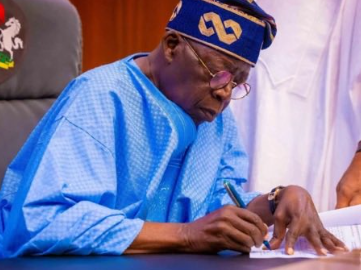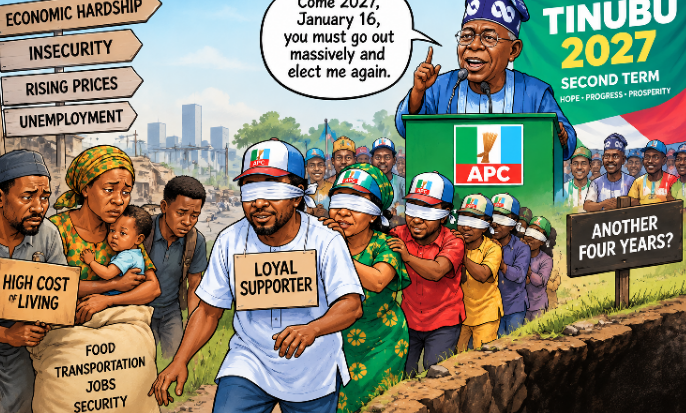
President Bola Tinubu’s decision to seek another four years in office raises a fundamental question that his campaign rallies, political alliances and impressive displays of party loyalty cannot answer: why should Nigerians give him another chance when millions are still struggling to survive the consequences of his administration’s economic policies?
As the All Progressives Congress (APC) flags off its presidential campaign ahead of the January 16, 2027, election, the president appears determined to consolidate his political machinery and persuade Nigerians that his leadership deserves another term. But beyond the crowds, slogans and declarations of support lies a harsher reality: a population grappling with rising living costs, expensive transportation, unaffordable food, persistent insecurity and a growing sense of uncertainty about the future. For many Nigerians, the question is no longer whether Tinubu has the political strength to seek re-election, but whether he has given the people sufficient reasons to renew his mandate.
If Tinubu genuinely appreciates the hardship his administration’s policies have imposed on ordinary Nigerians, he should understand that asking for another term is not a routine political exercise. It is a demand for renewed trust from people whose patience has been stretched by the daily struggle to afford the necessities of life. Trust is not secured by political declarations, nor can it be demanded from citizens who feel abandoned by the very government expected to protect their interests. It must be earned through responsible leadership, measurable progress and a willingness to acknowledge the consequences of policy decisions.
To be fair, the removal of petrol subsidies and the unification of foreign exchange arrangements were presented as necessary measures to address structural weaknesses in the Nigerian economy. Successive administrations had postponed difficult decisions, and the argument that the country could no longer sustain its previous economic arrangements deserves serious consideration. However, the justification for reform cannot become an excuse for the suffering that follows it. A government that asks citizens to endure painful sacrifices must demonstrate that those sacrifices are producing meaningful benefits and that the burden is not being disproportionately carried by the poorest members of society.
Unfortunately, the central grievance against Tinubu’s administration is not simply that it introduced difficult economic reforms, but that the relief many Nigerians expected has yet to match the scale of their hardship. When petrol prices rise sharply, transportation becomes more expensive, food prices climb and household incomes lose purchasing power, the consequences extend beyond economic statistics. They determine whether parents can adequately feed their children, whether students can afford transportation to school and whether small businesses can remain operational. For millions, economic policy is not an abstract debate about fiscal discipline; it is a daily battle for survival.
Against this background, Tinubu’s declaration that the opposition created the hunger and poverty Nigerians are experiencing raises serious questions about political accountability. Whatever the failures of previous administrations, the president cannot reasonably expect to escape responsibility for the conditions prevailing under his own government. Nigerians elected him to lead, not merely to identify the shortcomings of his predecessors. The responsibility of leadership is to confront existing problems, explain difficult decisions honestly and demonstrate how the government intends to improve the lives of its citizens.
Blaming political opponents may energise party loyalists, but it does little to reassure a mother who cannot afford a bag of rice, a commercial driver struggling with fuel costs or a young graduate who sees little prospect of meaningful employment. These citizens are not necessarily interested in which political party deserves the greater share of the blame for Nigeria’s problems. They want to know what the government is doing to make their lives better. A president seeking another term should be prepared to answer that question with evidence rather than accusations.
Yet, remarkably, Tinubu still commands enthusiastic followers who are prepared to defend his administration and campaign vigorously for his return. Their support presents an important political question: are they genuinely convinced that his policies will eventually deliver prosperity, are they benefiting from the political and economic arrangements surrounding his government, or have they become so committed to their political allegiance that they can no longer objectively assess its consequences?
Although It would be unfair to assume that all political supporter is a beneficiary of his administration as Political loyalty is believed to be often influenced by ideology, party identity, regional considerations, personal convictions and a genuine belief that a leader deserves more time to implement his plans. Some supporters may also believe that the alternatives are worse. These are legitimate considerations in democracy. However, when loyalty becomes an unquestioning defence of every government decision, regardless of its consequences for the wider population, it ceases to be constructive political participation and becomes an obstacle to accountability.
There is, nevertheless, a troubling possibility that some of the president’s most vocal supporters are those who enjoy access to political appointments, government contracts, patronage and other benefits of political power, while the wider population bears the cost of policies from which it sees little immediate relief. If that is the case, their enthusiasm may reflect the preservation of personal interests rather than a genuine assessment of the national interest. The question is whether they are campaigning for a better Nigeria or simply defending an arrangement that works in their favour.
For those who support Tinubu without receiving any such benefits, the challenge is different but equally important. They must ask themselves whether their loyalty is helping to improve governance or merely insulating those in power from criticism.
Democracy does not require citizens to agree with the opposition, but it does require them to examine the performance of their preferred candidates honestly. A supporter who cannot acknowledge obvious shortcomings in a government is not necessarily demonstrating political wisdom; such a person may simply be placing allegiance above reason.
This is where the biblical warning that if the blind leads the blind, both will fall into a ditch becomes relevant as a political metaphor. When leaders refuse to acknowledge the suffering of the people, and supporters refuse to question those leaders, the consequences can extend beyond the ruling party to the nation as a whole. Blind loyalty does not make a government more effective, just as unquestioning praise does not make failed policies successful. Rather, it encourages leaders to believe that political applause is evidence of public satisfaction, even when millions of citizens are struggling.
The danger, therefore, is not that Nigerians continue to support a president whose policies they believe in. It is that political enthusiasm becomes detached from the realities of ordinary life. A rally attended by thousands cannot automatically be interpreted as proof that the majority of citizens are satisfied with their economic circumstances. Political mobilisation demonstrates the ability to gather supporters; it does not necessarily establish that a government has earned the confidence of the entire electorate.
Tinubu’s choice of Kaduna for the campaign flag-off also underscores the importance of northern Nigeria to his re-election calculations. The region’s electoral strength, security concerns and economic grievances will be central to the contest. However, political calculations cannot indefinitely substitute for effective governance. Voters who supported the president in 2023 are entitled to reconsider their choices in 2027, just as those who opposed him are entitled to demand a credible alternative. Electoral loyalty should never be treated as a permanent entitlement.
The debate over Nigeria’s unwritten zoning arrangement further complicates the political contest. Regional inclusion matters in a country as diverse as Nigeria, and political power-sharing can help address legitimate concerns about exclusion. But zoning should not become a convenient distraction from the more urgent questions of economic welfare, security, accountability and competence as it is. Whether the next president comes from the North or the South, Nigerians will still need affordable food, reliable electricity, decent jobs, functioning schools and protection from violence. Regional balance is important, but it cannot replace responsible leadership.
Ultimately, Tinubu must understand that seeking re-election is his constitutional right, but granting him another mandate is the prerogative of the electorate. Nigerians do not owe him a second term simply because he occupies the presidency, commands the support of governors or has assembled an extensive political network. The people must judge him by what his administration has achieved, what it has failed to achieve and whether its promises offer a credible path towards a better future.
If the president believes his reforms are working, he should demonstrate their benefits in the lives of ordinary citizens. If he believes the opposition is responsible for the country’s difficulties, he should provide evidence rather than rely on accusations. And if he genuinely wants Nigerians to trust him again, he must first demonstrate that he understands the depth of their suffering and accepts responsibility for addressing it.
The same responsibility rests on his supporters. They must decide whether their loyalty is to a political personality or to the Nigerian people whose interests a president is elected to serve. Supporting a candidate is a democratic right; refusing to question that candidate is a dangerous surrender of civic responsibility.
Tinubu may have the political machinery to launch an ambitious re-election campaign, but machinery cannot feed hungry families, lower the cost of living by itself or guarantee the security of communities. Neither can slogans erase the memories of economic hardship. Before asking Nigerians to renew his mandate, the president must confront the question that millions are already asking: what has changed for the better, and why should we believe that another four years will be different?
For a nation weary of promises, the answer must be found in tangible improvements, not campaign rhetoric. Until the government can convincingly demonstrate that its policies are delivering relief to the people, Tinubu’s re-election bid will remain vulnerable to the very hardship his administration has struggled to contain.
The president may be asking Nigerians for another chance, but the people are entitled to ask whether he has earned it. And those who campaign for his return must ask themselves whether they are helping to lead Nigeria towards progress or, in their refusal to confront uncomfortable realities, helping the wrong that bleeds Nigeria.