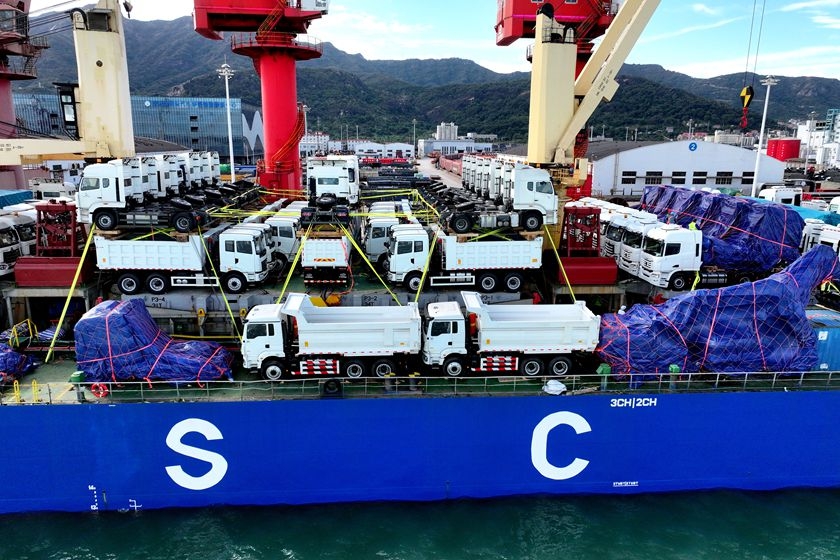
China’s export performance is approaching historic territory, with its trade surplus edging towards the $1 trillion mark in the first nine months of 2026 but beneath the impressive figures lies an increasingly complicated economic picture, as a significant portion of the latest export surge appears to have been driven by importers rushing orders ahead of anticipated trade restrictions rather than a sustained improvement in global demand.
Official figures released on October 14 showed that Chinese exports climbed 36.3 per cent year-on-year in September to $447.2 billion, representing an acceleration of 11.3 percentage points from August, a growth that signifies second-fastest monthly expansion recorded in 2026, behind February, and pushed China’s monthly trade surplus to $133.53 billion, its second-highest on record.
The remarkable performance was supported by stronger global demand for artificial intelligence infrastructure, particularly semiconductors, alongside a rush by international buyers to secure shipments before anticipated tariff deadlines and changes to China’s tax-rebate arrangements.
Semiconductor export values increased by more than 108 per cent during the first nine months of the year, highlighting China’s expanding position in global technology supply chains.
Yet, the figures may not represent the strength of demand as convincingly as they suggest.
Economists warn that front-loading, whereby importers accelerate purchases to avoid impending tariffs or regulatory restrictions, may have artificially inflated September’s performance. With several trade deadlines approaching, businesses in the United States and Europe had incentives to bring forward orders that might otherwise have been placed in subsequent months.
This raises questions about whether China’s export momentum can survive once those temporary incentives disappear.
Although exports reached $447.2 billion, imports stood at $313.7 billion, illustrating the country’s enormous trade advantage but also highlighting the persistent imbalance between its external manufacturing strength and domestic consumption.
China’s cumulative trade surplus reached $938.1 billion between January and September, putting the country on course to surpass the $1.189 trillion annual record established in 2025. The development comes despite growing pressure from Washington and Brussels over Beijing’s industrial overcapacity, trade practices and expanding dominance in strategic manufacturing sectors.
OCTOBER DATA TO TEST THE STRENGTH OF CHINA’S EXPORT BOOM
Attention has now shifted to China’s October trade figures, scheduled for release on November 10, which could provide a clearer indication of whether September’s exceptional performance reflected genuine demand or merely a temporary acceleration of shipments.
Early indications suggest that the export boom may already be losing some momentum. China’s official manufacturing Purchasing Managers’ Index fell to 49.3 in October, returning to contraction territory after September’s recovery. A reading below 50 indicates a decline in manufacturing activity and raises concerns about the strength of industrial production following the rush to fulfil advance orders.
Although analysts expect China’s trade surplus to remain relatively elevated, a significant slowdown in export growth could expose the extent to which September’s performance was sustained by orders borrowed from future months.
The implications extend beyond China’s manufacturing sector as prolonged slowdown in external demand could intensify pressure on Beijing to stimulate domestic consumption, particularly as its export-dependent economic model faces increasing resistance from major trading partners.
EUROPE TIGHTENS THE SCREWS ON CHINESE EXPORTS
While Washington continues to challenge China’s trade practices, Europe is increasingly demonstrating its willingness to adopt a tougher position against Beijing.
On October 9, the European Union and China reached an agreement aimed at halving Chinese hybrid vehicle shipments to the bloc following two days of negotiations between EU Trade Commissioner Maroš Sefčovič and Chinese Commerce Minister Wang Wentao in Beijing.
The discussions also covered rare earth export licensing and improved access for European businesses to the Chinese market.
The agreement followed months of pressure from Brussels, which had warned that China must demonstrate tangible progress in addressing the bloc’s concerns or face additional trade measures.
European manufacturers have become increasingly concerned about the rapid expansion of Chinese vehicle exports. China’s passenger car exports reportedly rose 64 per cent year-on-year in September to approximately 919,000 units, intensifying competition for European automobile producers already struggling with the transition to electric vehicles and mounting production costs.
Sefčovič described the agreement as “a crucial first step, but only a first step”, signalling that Brussels does not consider the arrangement sufficient to resolve its broader trade concerns.
Earlier, the EU’s chief trade enforcement officer, Denis Redonnet, had warned that “dialogue alone will not suffice”..
CHINA TURNS TO ASIA AS WESTERN MARKETS BECOME MORE HOSTILE
Faced with mounting restrictions and trade tensions in Western markets, China is increasingly redirecting its exports towards emerging economies, particularly across Southeast Asia.
The Association of Southeast Asian Nations (ASEAN) emerged as China’s largest export destination in September, with shipments to the region rising by more than 52 per cent year-on-year to $81.7 billion.
Chinese clean-energy products, including electric vehicles, lithium batteries, solar panels and electricity-grid equipment, have become particularly prominent in the region. Southeast Asia reportedly absorbed more than $20 billion worth of Chinese clean-technology products in 2026, representing an increase of approximately 50 per cent.
The expansion reflects Beijing’s broader strategy of diversifying its export markets while reducing its dependence on traditional Western destinations. However, the growing presence of Chinese manufacturers in emerging markets could eventually generate trade tensions in those regions as local industries struggle to compete with China’s manufacturing capacity and pricing advantages.
China’s export structure is also undergoing a significant transformation as electric vehicles, lithium batteries and wind turbines are increasingly replacing low-cost manufactured goods as major contributors to export growth. The transition demonstrates Beijing’s determination to move further up the global industrial value chain and establish greater control over strategic technologies.
However, this industrial transformation is also creating new tensions with advanced economies, which increasingly view China’s dominance in clean-energy manufacturing as a threat to their domestic industries and economic security.
Beijing’s influence over rare earth elements and other critical materials has further complicated the situation. Its control of important components of global supply chains has become an increasingly powerful geopolitical instrument, prompting affected countries to accelerate efforts to diversify their sources of strategic minerals and manufacturing inputs.