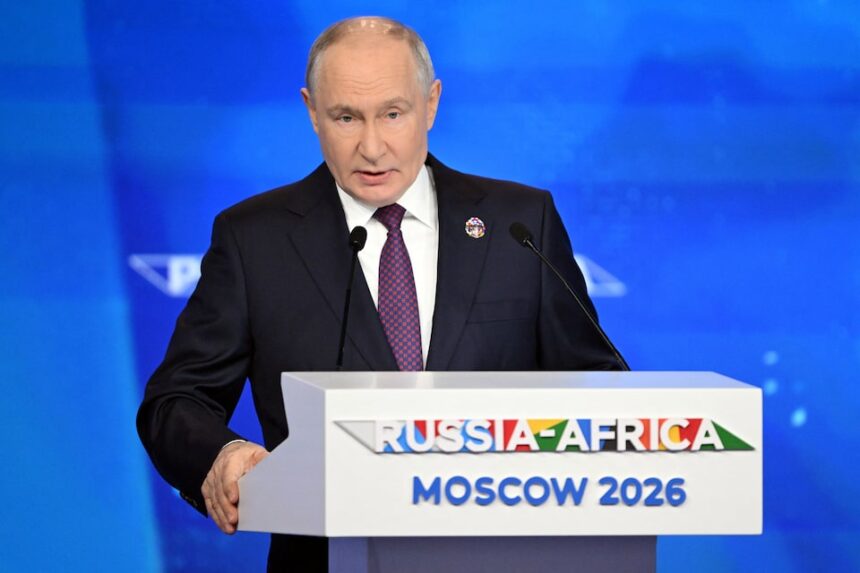
Russian President Vladimir Putin has intensified Moscow’s campaign to deepen its influence in Africa, portraying Russia as a more reliable development partner than Western powers, whom he accused of exploiting the continent through colonial-era practices, economic coercion and unsustainable debt.
Addressing the third Russia-Africa Summit in Moscow on Wednesday, Putin told African leaders that Russia was committed to sovereign development, technology transfer and industrial cooperation, contrasting Moscow’s approach with what he described as the West’s attempts to keep African countries financially dependent.
The two-day summit attracted government delegations from 48 countries, including 22 African leaders, highlighting Russia’s determination to strengthen its political, economic and security relationships across the continent.
Putin argued that Africa was emerging as an important force in global politics and the economy, noting that the continent’s growing sovereignty and determination to determine its own development path deserved greater international recognition.
He, however, accused Western countries of resisting the emergence of a multipolar world through sanctions, tariff wars, economic blackmail and interference in African affairs, while further allegig that Western financial arrangements were designed to push African countries into debt dependency at the expense of their long-term development.
In contrast, Putin promised cooperation that would go beyond extracting Africa’s natural resources, pledging Russian support for local manufacturing, job creation, infrastructure development and the transfer of digital technology.
He also advocated greater African representation in the decision-making structures of the International Monetary Fund and World Bank.
Moscow is equally seeking to expand its footprint in strategic sectors, including mining, energy, agriculture, transport and telecommunications.
Putin disclosed that Russia supplied 13 million metric tonnes of agricultural products to Africa in the first nine months of 2026, while more than 40 African countries already receive Russian grain and fertilisers. He added that approximately 40,000 Africans were studying at Russian universities.
The summit also comes amid growing Russian military and political involvement in parts of Africa, particularly the Sahel, where Moscow has sought to strengthen ties with military-led governments and displace traditional Western security partners. Russian paramilitary forces have faced allegations of supporting military juntas and abuses against civilians, claims Moscow has repeatedly rejected.
Burkina Faso’s Prime Minister, Rimtalba Jean Emmanuel Ouedraogo, defended his country’s relationship with Russia, describing the partnership as transparent and mutually beneficial. He contrasted Moscow’s engagement with France’s former colonial influence, arguing that Russia was not seeking to erase African languages and cultures.