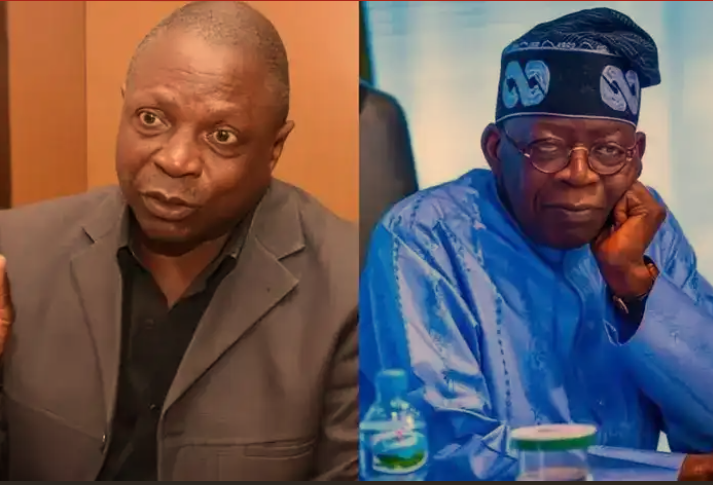
A fresh controversy has erupted over President Bola Ahmed Tinubu’s academic credentials following serious allegations by a former lecturer at Chicago State University (CSU) Dr. Adetokunbo Pearse, who has questioned the President’s account of his educational background.
Speaking in an interview on News Central TV, Pearse described Tinubu as a “professional liar” and insisted that the President never attended the institution, despite claiming to have obtained a degree from the university.
Pearse said he lectured at Chicago State University between 1985 and 1990 and was the director of the programme Tinubu allegedly claimed to have attended, arguing that his position at the institution gave him knowledge of the programme and its records.
He also questioned the educational information Tinubu submitted to the Independent National Electoral Commission (INEC), alleging that the President had listed schools he never attended rather than explaining that he was homeschooled. These are Pearse’s allegations and have not been independently established by his latest television appearance.
The former lecturer further claimed that he was approached around 1999 by individuals seeking information about Tinubu’s academic history in connection with an inquiry reportedly linked to the late Lagos politician, Funsho Williams.
Those seeking the information he said were directed to him, and that he provided them with records he he had access to.
He maintained that his knowledge of the matter was the reason he remained convinced that Tinubu’s account of his academic history was false.
Meanwhile, the remarks have attracted attention at a time when Nigeria is also facing renewed questions over government borrowing, debt accumulation and how much of the country’s public revenue is being committed to debt repayment.
The economic concerns are supported by recent figures from the Debt Management Office (DMO), which put Nigeria’s total public debt at ₦166.79 trillion as of June 30, 2026, representing an increase of ₦7.44 trillion compared with the end of March. Of this amount, ₦75.2 trillion was external debt, while ₦91.59 trillion was domestic debt.
The figures have intensified public debate about the country’s growing financial obligations and the long-term implications for future generations.
The borrowing debate has become even more significant following Tinubu’s November 2026 request for legislative approval to secure approximately $7.7 billion in additional external financing to support the 2026 budget. The proposal replaced an earlier request for $20.5 billion and €1.05 billion.
The administration has maintained that the funds would support infrastructure, security, agriculture, healthcare, education and other development priorities. However, critics have questioned whether continued borrowing is sustainable, particularly when the government is already carrying substantial debt-servicing obligations.
The controversy surrounding Tinubu’s academic credentials also requires some historical context as Chicago State University previously confirmed that Tinubu attended the institution between August 1977 and June 1979 and graduated with a Bachelor of Science degree in Business Administration.
The university reiterated its confidence in its records in a statement issued in September 2023. However, questions surrounding the specific diploma submitted to INEC became part of the legal dispute involving former presidential candidate Atiku Abubakar. A BBC investigation subsequently reported that it found no evidence that Tinubu’s submitted certificate was forged.
An important detail in Pearse’s latest allegations is that his stated period of employment at Chicago State University, 1985 to 1990, came several years after the university’s recorded dates of Tinubu’s attendance. This does not automatically invalidate Pearse’s claim about his knowledge of the programme or its records, but it makes the documentary evidence behind his assertion particularly important. His latest televised comments have not, by themselves, overturned the university’s previous confirmation.
Beyond the academic controversy, Pearse also criticised the Tinubu’s administration over what he described as worsening poverty, unemployment and insecurity. His remarks reflect broader public concerns about the direction of the country, particularly as Nigerians continue to contend with the cost of living and the economic consequences of government policies.
Therefore thess query how much confidence should Nigerians place in the statements and records presented by those seeking the highest political office, and how should the government be held accountable for the financial obligations it continues to place on the country? While Pearse’s allegations require further evidence and a response from the Presidency, Nigeria’s rising debt figures and latest borrowing proposals make transparency, accountability and responsible management of public resources increasingly