One disturbing feature of failing political leadership is the growing tendency to exploit the economic vulnerability of the electorate to secure political survival.
Rather than earn the people’s confidence through performance, accountability and policies that improve their living conditions, some governments resort to financial inducements, turning elections into transactions between desperate politicians and economically disadvantaged citizens.
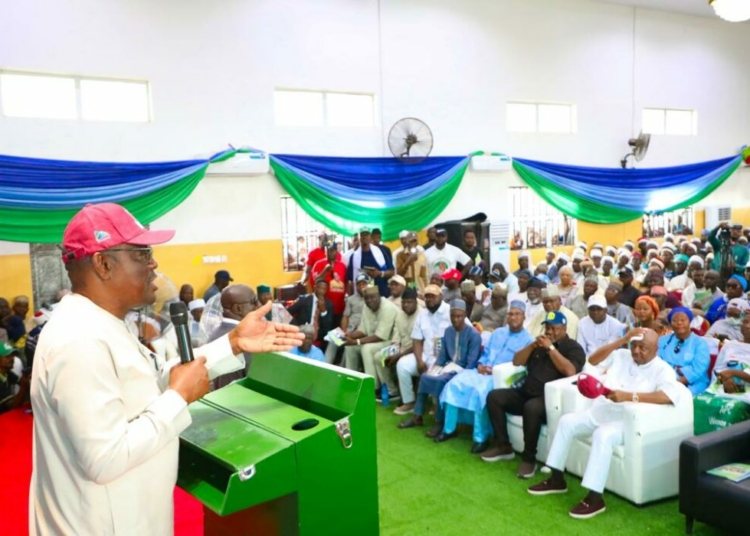
The recent promises by United States President Donald Trump and Nigeria’s Minister of the Federal Capital Territory, Nyesom Wike, offer striking examples of this political tendency.
While Trump promised every adult American $5,000 if Republicans won both chambers of Congress in the November midterm elections, Wike announced a proposed ₦10 million reward for councillors who successfully delivered their respective wards for President Bola Tinubu in the 2027 presidential election.
Beyond the difference in amounts and political circumstances, both promises raise fundamental questions about the integrity of democratic competition and the value politicians place on the electorate’s independent choices.
Trump’s promise, which could cost the American government approximately $1.3 trillion, attracted applause at the Republican convention but also provoked questions about its feasibility, funding and legality.
Coming amid rising living costs and public dissatisfaction with his administration’s policies, the proposal appeared to be an attempt to use financial incentives to regain political support.
However, the subsequent defeat of Republicans in the midterm elections demonstrated that monetary promises could not simply erase public dissatisfaction with governance while Trump’s eventual admission that his administration’s tough deportation policies had hurt him politically further exposed the consequences of policies that alienated sections of the electorate.
In Nigeria, Wike’s ₦10 million promise raises an equally troubling question. Why should elected councillors be offered financial rewards for delivering their wards to a presidential candidate? Are they being rewarded for their performance in public office or for their ability to influence voters towards a predetermined political outcome?
Although political mobilisation is legitimate in democracy, attaching substantial financial rewards to electoral outcomes creates an unhealthy incentive structure that undermines the independence of grassroots political representation. It also reinforces the perception that elections are contests to be won through financial muscle rather than public confidence.
More disturbing is the assumption that financially vulnerable citizens constitute an easily manipulated electoral resource. In a country where millions struggle with food inflation, unemployment, poor healthcare, inadequate electricity and declining purchasing power, politicians understand the desperation that economic hardship creates.
They can therefore present relatively attractive sums as generosity while avoiding the more important responsibility of creating an economy in which citizens do not have to depend on election-season handouts to survive.
This is the contradiction at the heart of transactional politics: governments that should be creating prosperity instead find political opportunities in poverty.
The electorate becomes valuable not necessarily because its welfare matters to those seeking power, but because its vulnerability can be exploited at election time. Such an approach is not empowerment; it is the commercialisation of democratic participation.
The African Democratic Congress (ADC) had earlier challenged the All Progressives Congress (APC) to test its popularity at the polls rather than rely on court orders and legal manoeuvres that the opposition considers attempts to suppress political competition.
The challenge speaks to a fundamental principle of democracy: a genuinely popular administration should have little reason to fear a free and competitive election. If a government has delivered on its promises, improved living conditions and earned the people’s trust, citizens should have sufficient reasons to demand its return without being persuaded through financial inducements.
Indeed, a government confident in its achievements should campaign on its record, not on how much money it can distribute or promise ahead of an election.
It should be able to point to improved wages, affordable food, reliable electricity, accessible healthcare, employment opportunities and better infrastructure as evidence of its performance. Where these achievements are visible, continuity becomes a choice the electorate can make willingly, not a political outcome that must be purchased.
Apparently, a government that considers financial inducements necessary to secure electoral support recognises, at least implicitly, that its performance may not be sufficient to earn the people’s confidence. It is a tacit admission of a deficit in public trust, particularly when the same government has failed to adequately address the economic conditions that make such offers attractive.
There is, therefore, a thin line between electoral mobilisation and vote trading when political loyalty is tied to financial rewards. Whether the money is promised directly to voters or channelled through elected grassroots officials, the underlying danger is the same: reducing the democratic process to a financial transaction. Democracy should give citizens the freedom to choose their leaders based on performance, competence and policy direction, not the opportunity to negotiate the highest political reward.
Woke and Trump should know that elections are not investment opportunities for politicians, nor are citizens commodities to be purchased by those seeking power. A government that performs well should not need to buy another mandate but should earn one.
Any political party that believes it enjoys genuine public support should have the courage to test that popularity through a free, fair and credible election.
Paying people to support a government is not a proof that the government has earned their support. It is simply be vote trading in disguise.