RIYADH — September 14, 2026:
Saudi Arabia’s ability to keep global oil markets supplied is facing a major threat after an attack shut down the East-West Pipeline, a critical route designed to bypass the strategically important Strait of Hormuz.
The kingdom reportedly has enough crude stored at the Red Sea port of Yanbu to sustain current export levels for only five to seven days without fresh supplies moving through the pipeline, according to newsmen, citing Saudi oil buyers and traders.
A prolonged shutdown could remove as much as four million barrels of crude from the global market daily, equivalent to roughly four per cent of worldwide oil supply. Such a disruption could intensify an already severe energy crisis and send crude prices higher.
Energy public policy analyst David Blackmon told the Daily Caller News Foundation that the damage appeared significantly more serious than an earlier incident in April. He warned that Saudi storage facilities in Egypt might compensate for the lost pipeline flows for approximately a week.
Blackmon said a prolonged outage could reduce global oil availability by about four million barrels per day, while further driving up crude prices and increasing pressure on American motorists.
The nearly 750-mile pipeline, owned by state-controlled oil giant Saudi Aramco, previously transported approximately four million barrels of crude daily from Saudi Arabia’s Eastern Province to Yanbu on the Red Sea.
Industry estimates regarding repairs remain divided. While some sources told newsmen that restoration could take five to six weeks, others believe partial operations could resume earlier.
The latest disruption comes as the International Energy Agency warns that the war involving Iran and the continuing restrictions on energy flows through the Persian Gulf are tightening the global oil market.
According to the IEA’s September Oil Market Report, global oil supply is projected to decline by 5.7 million barrels per day in 2026, representing roughly six per cent of total supply. The forecast is more severe than earlier projections, which anticipated a faster restoration of Middle Eastern oil flows.
Saudi Arabia has suffered a particularly significant production decline. Its crude supply reportedly fell by 2.3 million barrels per day in August to approximately six million barrels daily, the lowest level in more than three decades.
At the same time, global oil inventories have been depleted as countries draw on reserves to compensate for reduced production. newsmen reported that global oil stocks declined by approximately 3.1 million barrels per day in August, reaching their lowest level since 2023.
The latest attack therefore threatens to deepen a supply crisis that is already placing enormous pressure on producers, refiners, transport operators and consumers.
The Pipeline That Was Meant to Bypass Hormuz
The East-West Pipeline, also known as Petroline, has become increasingly important as the Iran war disrupts traditional shipping routes for Middle Eastern crude.
The pipeline transports oil from Saudi Arabia’s oil-producing Eastern Province across the Arabian Peninsula to Yanbu, enabling the kingdom to export crude without routing tankers through the Strait of Hormuz.
Before the war began on February 28, between 125 and 140 commodity vessels reportedly passed through the strait each day. The waterway also handled approximately one-fifth of global petroleum liquids consumption, making it one of the world’s most consequential energy corridors.
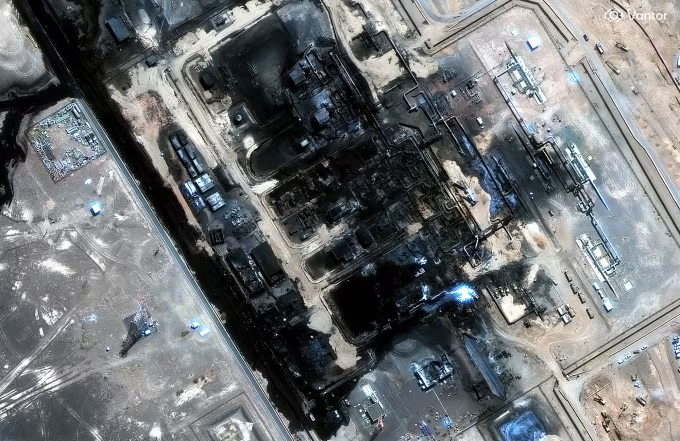
The East-West Pipeline was shut down following a drone attack, newsmen reported. Satellite imagery circulated online appeared to show a large smoke plume along the pipeline in the Saudi desert between Medina and Mahd adh Dhahab, while NASA’s FIRMS system detected significant heat activity along a stretch of less than 10 kilometres.
The incident has raised fresh concerns about the vulnerability of Saudi Arabia’s alternative oil-export infrastructure. The route that was intended to provide protection against disruptions in Hormuz is now itself under attack.
The security situation has also deteriorated around the Red Sea. Iran-aligned Houthi forces have reportedly intensified attacks on Saudi Arabia while advancing along Yemen’s Red Sea coast towards the Bab el-Mandeb Strait, another vital shipping passage.
Earlier this month, the Houthis claimed responsibility for attacks on Saudi energy facilities in Abha, Najran and Jizan, as well as an air base in Khamis Mushait. The attacks reportedly wounded 73 people and temporarily disrupted some operations after fires broke out.
With tanker traffic through Hormuz increasingly restricted, Saudi Arabia has relied more heavily on its Red Sea export terminals. Vortexa data showed that crude and condensate loadings at Yanbu rose to 3.7 million barrels per day in September, compared with 3.2 million barrels per day in August.
The East-West Pipeline had carried between four million and five million barrels of crude daily in recent months, according to newsmen. Its shutdown threatens to eliminate one of the few remaining alternatives to Hormuz just as Saudi Arabia needs those routes most.
Oil Shock Threatens Consumers and Industry
The market reacted swiftly to the disruption. Brent crude rose 2.8 per cent on Monday to $107.55 per barrel, while US West Texas Intermediate climbed 2.4 per cent to $102.49, according to the Wall Street Journal.
A prolonged outage could force global crude supplies to be redirected, complicate refinery operations and intensify competition for tanker capacity. Asian refiners that depend heavily on Middle Eastern crude could face particular difficulties.
The consequences are also being felt in the United States, where diesel prices have already climbed sharply. The national average reportedly exceeded $6 per gallon on Friday, reaching $6.06, compared with $3.71 a year earlier, according to AAA.
Diesel prices stood at approximately $3.72 per gallon before the Iran war began in February, indicating an increase of around 60 per cent in slightly more than six months.
The rise is particularly significant for the American freight industry. Trucks transported 11.27 billion tons of goods in 2024, accounting for 72.7 per cent of domestic freight tonnage, according to the American Trucking Associations.
Higher fuel costs consequently increase the expense of transporting food, packages, construction materials and other essential goods across the country.
The impact is also spreading through the agricultural sector. The Bureau of Labor Statistics reported that food prices rose 2.7 per cent in August compared with the previous year, while grocery prices increased 2.2 per cent. Fruit and vegetable prices rose 3.2 per cent, and non-alcoholic beverages climbed 3.7 per cent.
Farmers face additional pressure when energy costs rise. Agricultural machinery relies heavily on diesel, while natural gas is an important input in fertiliser production, according to the US Energy Information Administration.
The US Department of Agriculture projects that spending on fertiliser, lime and soil conditioners will increase by 15.3 per cent in 2026, representing an additional expenditure of approximately $5.3 billion.
The IEA has described oil flows through the Strait of Hormuz as “severely constrained.” Gulf diesel and gasoil exports reportedly averaged only 390,000 barrels per day in August, slightly more than one-quarter of their pre-war levels.
The agency also projects that global oil supply will decline by 5.7 million barrels per day in 2026, while a full recovery in Middle Eastern oil supplies may not occur until 2027.
The central concern is no longer simply whether Saudi Arabia can repair a damaged pipeline. It is whether the global energy system can withstand another major supply shock while its key routes, reserves and production facilities remain under pressure. If the East-West Pipeline remains offline for weeks, the world could face a sharper oil squeeze, higher transport costs and renewed inflationary pressures.