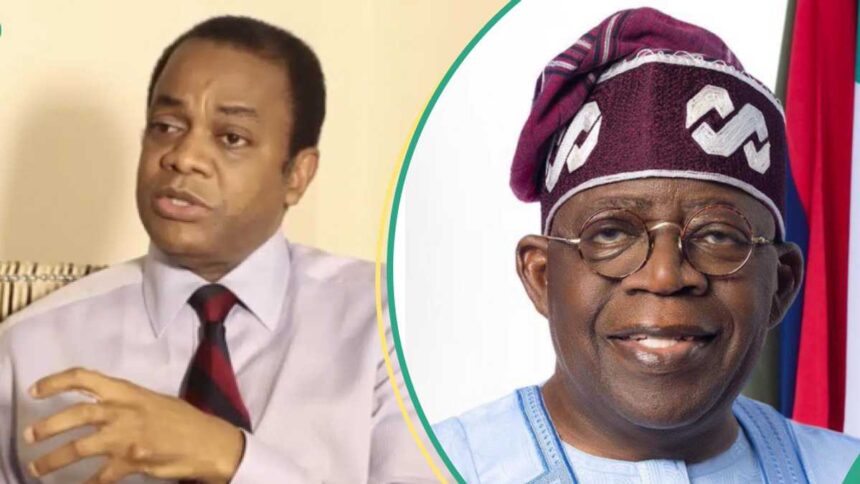
Former Cross River State governor and Peoples Redemption Party presidential candidate Donald Duke has renewed his criticism of President Bola Tinubu’s economic policies, arguing that the government’s approach to petrol pricing has strengthened public finances without delivering sufficient relief to Nigerian households.
Duke’s comments, published across Vanguard, SaharaReporters and Leadership, centre on a broader argument. He contends that Nigeria’s economic reforms should be judged by their effect on employment, household income and living standards, rather than by government revenue or foreign-exchange reserves alone.
His sharpest criticism is directed at the handling of the petrol subsidy.
According to Duke, the subsidy system that existed before Tinubu came to office was deeply flawed, but removing the old arrangement without creating a better system for protecting households has left Nigerians carrying much of the cost.
He described the present arrangement as a poorly managed replacement for the former subsidy regime, arguing that government finances have benefited while citizens and the wider economy have suffered.
Duke’s criticism presents a difficult question for the Tinubu administration: if subsidy removal was designed to free public resources for productive investment and improve Nigeria’s fiscal position, how quickly should Nigerians expect to see those gains reflected in their daily lives?
The government’s answer has been fundamentally different.
Tinubu has consistently defended subsidy removal as an unavoidable fiscal reform. In May 2026, the President said removing the subsidy saved Nigeria from imminent bankruptcy and created the foundation for economic recovery. He argued that the previous system consumed enormous public resources while benefiting a relatively small group.
The administration has also pointed to stronger government revenues, improved fiscal conditions, foreign-exchange reforms and increased investment as evidence that the reforms are producing results.
In August, the State House said the reforms had contributed to improved public finances and a more predictable operating environment for businesses. It also described subsidy removal as a key correction to longstanding economic distortions.
So the dispute is not really about whether Nigeria needed economic reform.
Nigeria clearly did.
The harder question is whether the reforms have been designed and implemented in a manner capable of transferring the benefits of macroeconomic adjustment to households.
Duke argues they have not.
He says Nigeria needs an economic model built around productive investment, employment, income growth and the development of the country’s natural and human resources. He proposed employment levels and income per capita as more meaningful measures of economic wellbeing than the headline size of foreign reserves.
That argument deserves serious consideration.
Foreign reserves are important. Fiscal stability matters. Government revenue matters. Exchange-rate stability matters.
But none of these indicators, by themselves, tells a Nigerian parent whether the household has enough money for food, transport, rent, school fees or healthcare.
A government might improve its balance sheet while households continue to struggle.
The same tension has featured in broader assessments of the Tinubu reforms. Leadership recently noted the distance between Nigeria’s improving macroeconomic indicators and the economic experience of households, with inflation, petrol prices, currency depreciation and business costs continuing to shape public perceptions of the reforms.
The government’s own statements acknowledge the sacrifice involved.
In his third-anniversary address, Tinubu said the reforms had imposed significant pressure on families, workers and businesses. He also acknowledged that the government’s next task was to ensure that the benefits of reform reached ordinary Nigerians more directly.
That admission points to the real test facing the administration.
Reform is not an end in itself.
The purpose of correcting fiscal distortions is to create an economy capable of producing more jobs, better incomes, stronger businesses and better public services.
If those outcomes take too long to materialise, public support for reform will inevitably weaken.
Duke’s intervention also comes at a politically significant moment.
With the 2027 presidential contest approaching, economic policy is becoming central to the political debate. Opposition parties are seeking to turn the cost of living and household hardship into evidence against the continuation of Tinubu’s economic programme, while the administration and its supporters argue that reversing the reforms would return Nigeria to the fiscal weaknesses that preceded them.
The debate should move beyond both positions.
Nigeria should neither romanticise the old subsidy regime nor assume that removing the subsidy automatically produces prosperity.
The old system carried serious fiscal and governance problems. Tinubu was right to confront a system his administration considered unsustainable.
But the removal of a distortion does not, by itself, build an economy.
The money and fiscal space created by reform must translate into productive capacity.
That means reliable electricity for manufacturers. Better roads and rail infrastructure. Efficient ports. Industrial financing. Agricultural processing. Skills development. Mass employment. Stronger public transport. Better healthcare. Better schools.
The administration itself has recognised the need for such measures. Its response to the initial shock included plans for CNG buses, agricultural investment, support for small businesses, food distribution and cash transfers.
The question is whether such interventions are sufficient in scale, well targeted, and sustained long enough to change household outcomes.
There is also a larger issue of economic accountability.
If government asks citizens to endure painful reforms in the name of a better future, government must show where the gains are going.
Nigerians deserve transparent answers about how additional revenues are being allocated, which investments are producing jobs, how productivity is improving and whether household incomes are rising in real terms.
Duke’s criticism therefore raises an issue bigger than petrol.
It raises the question of who Nigeria’s economic reforms are ultimately designed to serve.
A successful reform programme should strengthen government finances and improve citizens’ welfare. Those objectives should reinforce each other.
If government revenue rises while household purchasing power continues to deteriorate, the administration faces a communication and policy problem.
If macroeconomic stability improves while productive employment remains weak, the reform programme still has unfinished work.
And if citizens are repeatedly told to wait for the benefits of reform without seeing credible evidence of those benefits, frustration will grow.
The Tinubu administration has made a legitimate case for correcting Nigeria’s longstanding economic distortions. The opposition also has a legitimate responsibility to test whether the government’s chosen methods are delivering the promised social and economic outcomes.
The standard should be neither Tinubu nor Duke.
The standard should be the Nigerian citizen.
The ultimate measure of economic reform is simple: Are Nigerians becoming more productive, more secure and better able to afford a decent life?
Until the answer is clearly yes, the argument over Tinubu’s economic policies is far from settled.