Canadian Prime Minister Mark Carney has rejected suggestions that closer ties between Canada and the European Union are intended to create a new geopolitical bloc to rival the United States.
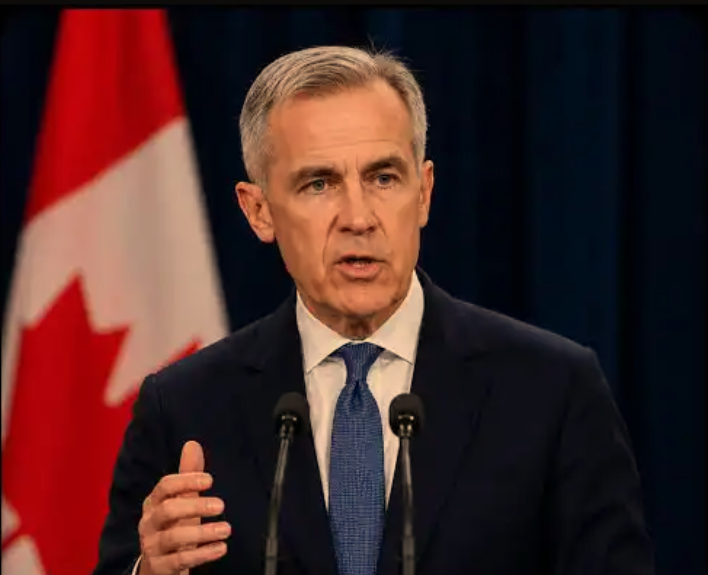
Speaking to the European Parliament on Thursday, Carney said a proposed Canada-EU alliance was designed to strengthen economic and political resilience rather than create another great-power rivalry.
“I’m not proposing a third bloc in order to become a great power rival, only with better manners,” Carney said, in an apparent reference to U.S. President Donald Trump’s confrontational approach to trade.
Carney said Canada was seeking greater resilience so that its open markets, sovereignty, democratic institutions and territorial integrity could not be threatened or undermined by external pressure.
The proposal comes amid growing trade tensions between Canada and the United States, Ottawa’s largest trading partner. The European Union has also faced repeated trade disputes with Washington.
EU Commission President Ursula von der Leyen on Wednesday suggested that Canada could become the bloc’s first “associate member”, although no such formal status currently exists within the EU. Trump subsequently warned that Washington could impose “very heavy tariffs” on Europe if it regarded a new Canada-EU agreement as a hostile act.
Carney said Canada was not seeking full EU membership but welcomed closer institutional ties.
“This is an opportunity to make Canada stronger, more sovereign, more independent, more prosperous, more sustainable,” he told reporters.
Trade, energy and defence
Carney outlined several areas where Canada and Europe could expand cooperation, including critical minerals, energy, defence production, artificial intelligence, payments and scientific research.
Canada could supply Europe with liquefied natural gas and hydrogen, while both sides could work together on AI safety standards and other emerging technologies.
Carney also called for stronger educational and people-to-people links. He said Canada should be allowed to participate in the EU’s Erasmus+ and Horizon programmes, which support education, training and scientific research.
He further proposed expanded opportunities for young Canadians and Europeans to live, work and study on either side of the Atlantic.
The proposed partnership has received support from some European leaders, but the idea of “associate membership” has also drawn reservations.
German government spokesperson Stefan Kornelius said Berlin supported an especially close partnership with Canada but suggested that the terminology should be reconsidered.
Carney played down the debate over the name, saying the “precise nomenclature” was a matter for Europe and that the substance of the relationship was more important.
Further details could be discussed at an EU-Canada investment summit scheduled to take place in Montreal next month.
A growing economic relationship
Canada and the EU already have significant economic ties through the Comprehensive Economic and Trade Agreement (CETA), provisionally applied since 2017. However, the agreement has yet to be fully ratified by all EU member states.
Bilateral trade in goods and services reached €130.8 billion ($151 billion) last year, according to the European Commission, representing an increase of more than 80 percent over the past decade.
The EU’s major exports to Canada include cars, machinery and pharmaceuticals, while Canada supplies Europe with crude oil, fertiliser, critical minerals and base metals.
Carney said deeper cooperation with Europe would not mean turning away from the United States, but rather broadening Canada’s economic and strategic partnerships at a time of heightened global uncertainty.