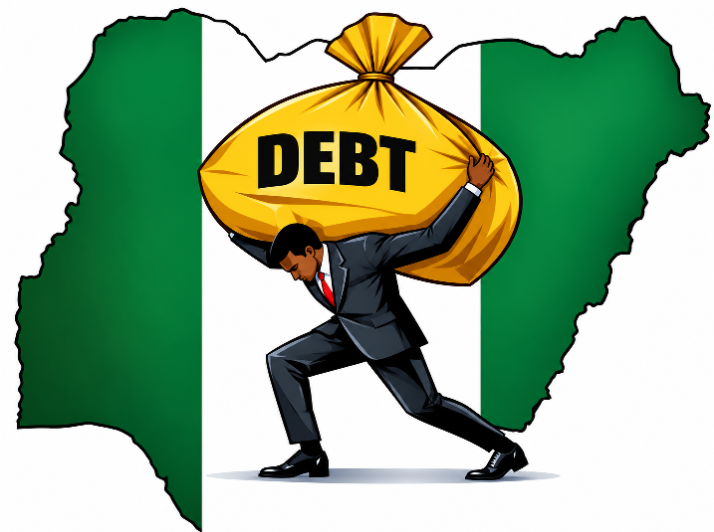
Nigeria’s latest debt figures should provoke something deeper than the familiar alarm over how much the country owes with government gets loans as if it is free.
Again the Federal Government is negotiating three fresh World Bank facilities worth $1.5 billion even as public debt has climbed to a record N166.79 trillion.
The paramount concern now is Nigeria borrowing too much, while the obvious is that it is borrowing not intelligently enough to transform debt into productive capacity, stronger revenues and a better quality of life for its citizens.
There is nothing inherently wrong with borrowing. Economies, governments and even the world’s most powerful nations borrow. The United States, for instance, carries a debt measured in tens of trillions of dollars, yet its enormous economy, deep financial markets, productive capacity and global economic influence mean that the size of its debt alone does not make it an economically poor country. The lesson for Nigeria is not that debt does not matter, but that debt must be assessed against the strength of the economy that supports it.
This is where Nigeria’s predicament becomes more troubling. The country is richly endowed with crude oil, natural gas, solid minerals, vast agricultural land and a huge human population. Yet millions of Nigerians continue to struggle with high living costs, inadequate infrastructure, unemployment and weak purchasing power. Nigeria may be a country endowed with resources, but resource abundance has not translated sufficiently into broad-based prosperity. The paradox is glaring: a nation blessed with enormous natural wealth continues to borrow to finance essential development while its citizens question where the wealth has gone.
The proposed World Bank loans illustrate both sides of the argument. The $500 million additional financing for the Agro-Climatic Resilience in Semi-Arid Landscapes project is intended to address land degradation, water insecurity, erosion, flooding, irrigation and climate vulnerability. Another $500 million facility is proposed for social protection, while a further $500 million would finance early childhood development. These are not, on their face, frivolous purposes. Climate resilience, social protection, education, health and childhood development are legitimate investments in national development.
But legitimate purposes do not automatically guarantee successful outcomes. Nigeria has accumulated years of development loans, yet the country still struggles with many of the same structural problems. The question that must accompany every new borrowing proposal should therefore be simple and uncompromising: what measurable improvement will Nigerians receive for every dollar borrowed?
That question becomes even more urgent against the latest Debt Management Office figures. Public debt increased from N152.40 trillion in June 2025 to N166.79 trillion in June 2026, while external debt stood at $54.52 billion. Domestic debt accounted for N91.59 trillion. Treasury bills alone increased sharply to N19.48 trillion, suggesting that short-term domestic borrowing is playing an increasingly significant role in government financing.
The Federal Government must explain not merely why it needs more money, but how these borrowings fit into a coherent debt-management strategy. Nigerians deserve to know how much is being borrowed for infrastructure, how much for social programmes, how much for refinancing, and how much ultimately translates into assets or productive capacity.
There is also an important distinction between concessionary borrowing and expensive commercial borrowing. World Bank IDA financing generally comes with more favourable terms than borrowing from commercial markets. That makes the proposed facilities materially different from high-cost borrowing. Yet favourable terms cannot excuse poor utilisation. A cheap loan wasted on an ineffective project remains a liability.
The United States provides an instructive contrast, but not a template that Nigeria can simply copy. America’s enormous debt exists alongside a highly productive economy, a globally dominant currency, deep capital markets, substantial tax capacity, sophisticated financial institutions and a large economic base capable of supporting substantial government borrowing. Nigeria does not possess these advantages to the same degree. Consequently, comparing the two countries merely by the size of their debts would be misleading.
The more useful comparison is the relationship between borrowing and economic capacity. A country can carry substantial debt and remain prosperous if its economy continually generates enough income, investment and productivity to support its obligations. Conversely, a country with a much smaller debt burden can experience severe economic distress if its revenues are weak, its borrowing costs are high and borrowed money fails to generate productive returns.
Nigeria’s challenge, therefore, is not simply its debt stock. It is the combination of rising obligations, limited government revenue, infrastructure deficits, widespread poverty and the persistent difficulty of converting abundant natural resources into broad-based economic wealth.
Inflation adds another dimension. The United States, like other major economies, has experienced periods of significant inflation and continues to manage price pressures through monetary and fiscal policies. But Nigeria’s problem is more structural: when inflation remains high while productivity and household incomes struggle to keep pace, the real burden is felt most sharply by ordinary citizens. Food, transport, housing, healthcare and education consume an increasing portion of household income. In such circumstances, even an apparently successful macroeconomic reform can feel like economic failure to the citizen whose purchasing power has deteriorated.
This is why government must be careful about celebrating increased borrowing as evidence of economic strength. Debt is not development. Debt finances development only when it is transformed into infrastructure, human capital, productive industries, stronger institutions and economic opportunities that ultimately expand the country’s capacity to repay.
Nigeria must also confront the uncomfortable question of accountability. If borrowed funds are directed into projects that do not generate measurable economic or social returns, future generations will inherit the liabilities without inheriting corresponding benefits. But if borrowing is transparently invested in productive assets, climate resilience, human capital and economic infrastructure, it can become an instrument for intergenerational development rather than merely an accumulation of obligations.
The Federal Government should therefore publish clear performance indicators for every major loan. Nigerians should be able to track how much was borrowed, where the money went, what was delivered, what it cost and what measurable benefit resulted. The National Assembly and relevant oversight institutions must also exercise meaningful scrutiny rather than treating loan approval as a routine administrative exercise.
Nigeria is not poor because it borrows. Nor is the United States rich simply because it can borrow enormously. The fundamental difference lies in productive capacity, institutional strength, revenue generation, investment quality and the ability to turn borrowed capital into sustainable economic value.
The real danger is not borrowing itself. It is borrowing without transformation.
A country blessed with oil, gas, minerals, fertile land and millions of talented people should not continually find itself borrowing to address problems that ought to have been reduced through decades of resource wealth and investment. If the new $1.5 billion World Bank financing is approved, the government must ensure that Nigerians can eventually point to the schools, livelihoods, restored land, improved water systems, productive communities and stronger institutions created with the money.
Otherwise, Nigeria risks leaving its children with something far less valuable than the natural resources inherited from previous generations: a mountain of debt without a corresponding mountain of assets.