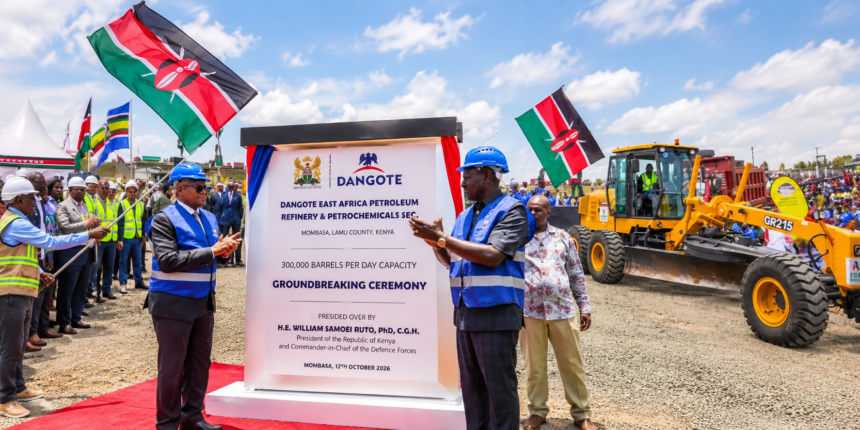
Kenyan President William Ruto has disclosed that Nigerian billionaire Aliko Dangote abandoned plans to establish a cement factory in Kitui County after becoming frustrated by demands and difficulties surrounding the proposed investment.
Ruto said the experience highlighted challenges that had discouraged major investors from committing capital to Kenya, including alleged demands for shares and bribes by individuals seeking to benefit from investment projects.
The President made the disclosure during a media engagement in Mombasa on Thursday, October 1, 2026, while announcing that a new investor had been secured to establish a KSh33 billion cement factory in Kitui.
“The investor is already around, and I will be soon visiting Kitui, probably next month, to break ground for the factory, which will cost KSh33 billion,” he said.
Ruto recalled that Dangote had previously sought to establish a multi-billion-shilling cement processing plant in Kitui but eventually abandoned the plan and redirected his investment to Tanzania.
He said he personally facilitated a meeting between Dangote and former President Uhuru Kenyatta while serving as Deputy President in an effort to advance the proposed investment.
“Dangote could have done the work seven years ago, but unfortunately he was frustrated so he chose to invest in Tanzania,” Ruto said.
The President did not disclose the specific demands allegedly made to Dangote or identify the individuals involved. However, he said pressure on investors to surrender shares and demands for bribes had contributed to difficulties in attracting large-scale investments into the country.
Ruto said his administration was working to eliminate such obstacles by creating a more predictable business environment while ensuring that Kenyans benefit from major investments through employment and other economic opportunities.
Dangote’s abandoned Kitui project was potentially significant because the county has substantial mineral resources suitable for cement production. A major cement investment could also have created jobs, expanded local supply chains and generated additional economic activity and revenue for the region.
The episode also illustrates the competition among African countries for major private-sector investments, particularly where investors are weighing access to raw materials, infrastructure, markets, regulation and the overall cost of doing business.
However, Ruto’s account represents the Kenyan President’s explanation of why Dangote abandoned the project. The specific demands allegedly made to the businessman, the identities of those involved and the precise circumstances surrounding his decision have not been independently established in the account.
The disclosure comes as Dangote continues to expand his industrial and energy interests across Africa, with the latest development involving a $160 million petroleum infrastructure project linking Ethiopia and Djibouti.
Dangote Group, in partnership with Ethiopian Investment Holdings, is developing the project to connect Damerjog in Djibouti with Dewele in Ethiopia through a 120-kilometre multiproduct pipeline, supported by petroleum storage and distribution facilities at both ends.
The project was unveiled at a groundbreaking ceremony at the Djibouti Damerjog Industrial Park attended by Ethiopian Prime Minister Abiy Ahmed, Djiboutian President Ismail Omar Guelleh and Dangote.
Abiy described the pipeline as a strategic investment that would reduce logistics costs and delays along the Ethiopia-Djibouti corridor while strengthening energy security and supply-chain resilience.
“Together with President Ismail Omar Guelleh and Aliko Dangote, we announce today a major strategic investment connecting Damerjog in Djibouti to Dewele in Ethiopia through a new refined petroleum products pipeline, supported by storage terminals at both ends,” Abiy said.
The infrastructure is expected to reduce Ethiopia’s dependence on long-distance road transportation of petroleum products from Djibouti, easing pressure on the busy trade corridor while reducing congestion, road-safety risks and environmental concerns associated with tanker movements.
Dangote said the pipeline would improve the reliability and distribution of petroleum products for critical sectors, including aviation, transportation, agriculture, construction and industry.
“Upon completion, as mentioned, Ethiopia will gain greater energy security and fewer logistics bottlenecks,” he said.
The project is expected to support the movement of products including jet fuel, automobile gas and Premium Motor Spirit, while increasing storage capacity and improving quality control across the supply chain.
Dangote noted that the Djibouti corridor handles most of Ethiopia’s import and export trade, making the route strategically important to the region.
“Today, the Djibouti corridor carries most of Ethiopia’s import and export trade. This includes petroleum products. The corridor is therefore one of the region’s most strategic economic arteries,” he said.
For Djibouti, the project is expected to increase activity around its port and logistics infrastructure, boost government revenues and create opportunities for local businesses. Dangote said it would also generate employment during construction and create permanent technical and administrative jobs when operations begin.
Contractors, suppliers, transport operators and host communities are also expected to benefit from the development.
The pipeline adds to Dangote Group’s expanding energy and industrial investments across Africa as the conglomerate seeks to strengthen regional infrastructure, deepen intra-African trade and reduce dependence on imported products.
The group is also expanding the Dangote Petroleum Refinery in Nigeria, which has a production capacity of 700,000 barrels per day, with plans to raise capacity to 1.4 million barrels per day.
Dangote has consistently positioned the group’s investments as part of a broader effort to support African industrialisation and build infrastructure capable of strengthening economic integration across the continent.
The Damerjog-Dewele pipeline will therefore connect Djibouti’s maritime and logistics infrastructure with Ethiopia’s large inland market, placing Dangote at the centre of another major cross-border energy investment in Africa.
For Kenya, meanwhile, the abandoned Kitui project remains a reminder of the importance of investor confidence. With a new KSh33 billion investor now lined up, the success of the replacement project will provide a practical test of whether the investment environment Ruto says his administration is improving can deliver the stability and predictability required by major investors.