Canadian Prime Minister seeks unprecedented partnership with 27-member bloc as Ottawa and Brussels set June deadline for negotiations amid uncertainty over membership terms and financial implications.
Canadian Prime Minister Mark Carney has declared that his government is working towards making Canada the European Union’s first associate member, signalling his strongest commitment yet to an unprecedented partnership that could significantly reshape the country’s political and economic relationship with Europe.
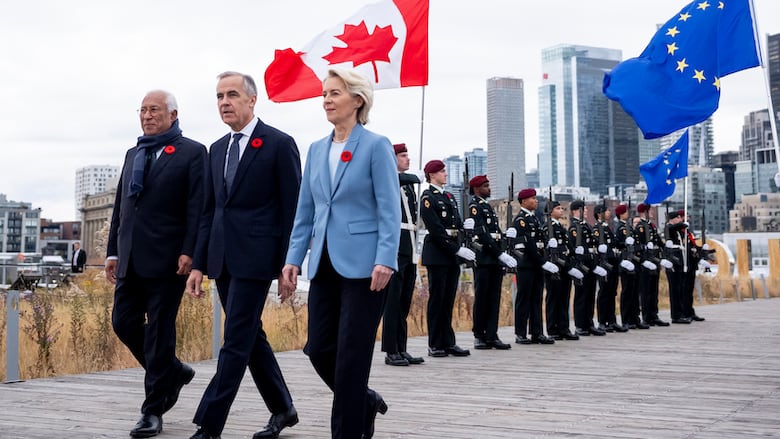
Carney made the declaration on Friday at the conclusion of the Canada-EU summit in Montreal, where he hosted European Commission President Ursula von der Leyen and European Council President António Costa. The proposed arrangement is intended to establish a relationship deeper than conventional international partnerships without requiring Canada to become a full EU member.
“We are working toward the deepest possible partnership, short of accession because of our geography, with Canada becoming the European Union’s first associate member,” Carney said in his closing remarks.
He added that both sides would determine the substance, scale and scope of the proposed arrangement over the coming months, indicating that significant negotiations remain before the initiative can become a formal agreement.
The prime minister also disclosed that negotiations are expected to be concluded by June, when he plans to participate in European Council meetings. As part of the process, Carney, von der Leyen and Costa will convene the European Commission’s College of Commissioners and Canada’s federal cabinet in March to advance discussions.
The proposal, however, faces considerable uncertainty, particularly over its legal framework, financial implications and the level of political support within the European Union.
Although von der Leyen initially introduced the associate membership idea in a speech last month and has continued to champion it, the proposal has encountered resistance from some EU members, with Germany reportedly emerging as one of its strongest opponents.
The disagreement became evident during the preparation of the joint statement issued at the end of the Montreal summit. Sources familiar with the negotiations disclosed that the expression “associate member” was removed from an earlier draft following objections from some member states. Germany reportedly described the terminology as a red line.
Consequently, the final declaration adopted more cautious language, committing both sides to pursuing “an ever-closer association of Canada to the EU, short of full membership itself.”
The controversy reflects the absence of an established framework for associate membership within the European Union. A Canadian government official, speaking on background after the summit, acknowledged that there was currently no formal process for admitting a country under such an arrangement.
The official also could not specify the legislative changes that might be required in Canada or across the EU’s 27 member states to make the proposal possible.
Financial questions have equally remained unanswered. Asked about the potential cost of the arrangement, Carney dismissed the suggestion that Canada was seeking to purchase membership, insisting that the initiative was about bringing both sides closer together.
“We don’t view this as paying for something, we view this as coming together,” he said.
Nevertheless, the financial obligations associated with the proposed partnership remain unclear, particularly given the range of programmes and institutional arrangements that could accompany a deeper relationship.
Despite the disagreements over its proposed designation, Canada and the EU concluded several negotiations and announced fresh commitments covering trade, investment, technology, security and international development.
Among the agreements finalised was an arrangement between Canada and the European Investment Bank to support investments in critical Canadian resources, particularly critical raw materials. Both sides also concluded negotiations on measures to counter anti-competitive activities.
They further completed negotiations on a digital trade agreement designed to provide greater legal certainty and facilitate cross-border data transfers between Canada and European countries.
Another agreement will give Canadian researchers and businesses access to European supercomputers, strengthening cooperation in advanced computing and scientific research.
Canada is also expected to participate in a European Union programme providing financial assistance to Ukraine, known as the Ukraine Support Loan.
Beyond the concluded agreements, Ottawa and Brussels pledged to expand opportunities for their citizens to study, work and undertake research in each other’s territories, while also agreed to begin discussions on international connectivity through new subsea cable infrastructure linking Canada, Europe and Asia.
Other areas of cooperation identified in the joint declaration include Arctic security, combating foreign information manipulation and interference, artificial intelligence safety and security, border protection and climate change.
The two sides also expressed support for reforming the World Trade Organisation rather than replacing the existing multilateral trading system.
Explaining the broader objective of the partnership, Carney said closer cooperation would strengthen national sovereignty and improve the ability of both sides to withstand external economic and geopolitical shocks.
“It means, at its base, sovereignty. Greater resilience [and the] ability to withstand shocks together,” he said.
However, Canada’s opposition has questioned whether the summit’s ambitious declarations would translate into tangible economic benefits for ordinary citizens.
Opposition Leader Pierre Poilievre dismissed the outcome as an exercise in political rhetoric, arguing that the government had failed to demonstrate how the proposed partnership would address the country’s domestic economic challenges.
He criticised the prospect of Canada aligning more closely with European policies on taxation, public debt, immigration and the energy industry, describing some of the bloc’s policy approaches as damaging.
“There was a lot of talk at the summit about aligning Canada with the insane European taxes, debt, immigration and anti-oil and gas policies that have left parts of Europe bankrupt and burning,” Poilievre wrote on social media.
He questioned whether the agreements would reduce mortgage payments, rents, food costs or fuel prices for Canadians.
The summit comes against the backdrop of growing uncertainty in Canada’s traditional relationship with the United States under President Donald Trump. Ottawa’s renewed engagement with Europe is widely viewed as part of a broader effort to diversify its economic and strategic partnerships amid tensions with Washington.
However, political developments within Europe could complicate the initiative.
In France, Marine Le Pen’s far-right National Rally is gaining political ground ahead of the 2027 presidential election. Le Pen, who has advocated stricter immigration controls, has also criticised the EU-Canada trade agreement.
Germany is equally facing growing political pressure from the Alternative for Germany (AfD), an increasingly influential far-right party that has challenged several established European political positions.
Asked whether possible changes in European political leadership could undermine the proposed partnership, Carney expressed confidence in the EU’s democratic institutions, arguing that the bloc’s commitment to democracy, freedom and the rule of law had sustained its development across successive political administrations.
He also rejected suggestions that the negotiations were being accelerated to secure an agreement before France’s presidential election, insisting that the initiative was driven by long-term interests rather than electoral considerations.
Although Carney, von der Leyen and Costa have publicly endorsed the associate membership concept, its implementation is far from guaranteed. EU member states would have to approve the arrangement, while the Canadian government has also indicated that any new partnership would be subjected to parliamentary debate and a vote.
For now, the Montreal summit has produced a broader framework for cooperation and several concrete agreements, but the most politically ambitious component remains unresolved.