The Federal Government’s decision to offer a ₦60-per-litre discount on petrol sold by the Nigerian National Petroleum Company Limited (NNPCL) for 30 days has raised fresh questions about the sustainability of its economic policies and the adequacy of its response to Nigerians’ worsening living conditions.
The initiative’s intent to ease transportation costs, its limited duration and modest reduction in pump prices underscore the growing disconnect between government interventions and the financial realities confronting millions of citizens. At a time when hunger, poverty, unemployment and rising living costs continue to place households under severe pressure, Nigerians need more than a temporary and ridiculous adjustment to petrol prices; they need a credible strategy for restoring purchasing power and economic stability.
The Minister of Finance and Coordinating Minister of the Economy, Taiwo Oyedele, announced the initiative on Thursday 8th October 2026 during a press briefing on fuel prices and subsidy-related concerns in Abuja.
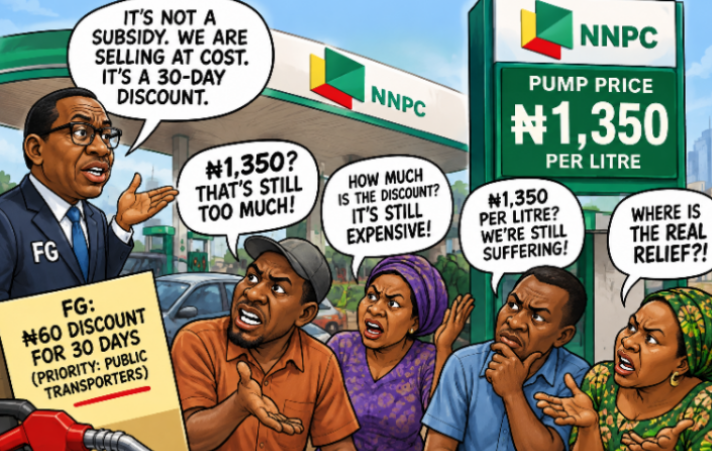
He explained that the discount would apply to petrol dispensed by NNPCL for an initial period of 30 days, with priority given to public transport operators nationwide. He added that the minister, the arrangement does not constitute a fuel subsidy but requires the government-owned oil company to sell petrol at cost by foregoing its retail profit margins.
Under the arrangement, the ₦60-per-litre reduction is expected to bring the targeted pump price down to a ceiling of ₦1,350 from an average of about ₦1,400 per litre. While the government may consider the intervention a necessary step towards cushioning the effects of high fuel prices, the question remains whether such a reduction can provide meaningful relief to Nigerians whose earnings have been severely weakened by successive increases in the cost of living.
The problem is not that the government has introduced a discount; rather, it is whether the discount is proportionate to the hardship it is intended to address. A reduction of ₦60 per litre may produce some savings for transport operators and other eligible beneficiaries, but it does little to reverse the broader inflationary pressures associated with expensive petrol. For commuters, traders, farmers and small-business owners, fuel prices influence almost every aspect of economic activity. When transportation becomes expensive, food distribution costs rise, businesses increase their prices, and household budgets become increasingly difficult to manage.
The Federal Government must therefore recognise that the economic consequences of petrol price increases extend far beyond filling stations. The cost of moving agricultural produce from farms to markets, transporting workers to their workplaces, distributing manufactured goods and operating small businesses is closely linked to the cost of energy. Consequently, a temporary discount that does not significantly alter these underlying costs may provide only marginal relief while leaving the wider cost-of-living crisis largely untouched.
There is also the question of access and accountability. By prioritising public transport operators, the government appears to recognise the importance of transportation costs in determining the financial burden on ordinary citizens. However, the success of this approach will depend on whether transport operators actually pass the savings to passengers. Without a transparent monitoring mechanism, there is no guarantee that commuters will experience any corresponding reduction in fares. The government must clearly identify participating operators, explain how the discount will be administered and establish a system for measuring its impact on transport costs, such which is unrealistic.
The timing of the announcement is particularly significant, coming amid renewed pressure from organised labour over petrol prices and workers’ declining purchasing power.
On Thursday, October 8, 2026, the Nigeria Labour Congress (NLC) issued a two-week ultimatum to the Federal Government, demanding a reduction in petrol prices and the commencement of negotiations on the national minimum wage.
The ultimatum was contained in a communiqué signed by NLC President Joe Ajaero after a joint meeting of the union’s National Executive Council and Central Working Committee in Abuja.
At the meeting, labour leaders deliberated on the state of the nation, worsening economic hardship, rising living costs and what the union described as existential threats confronting workers and the wider population. The NLC’s position reflects a broader concern that the relationship between wages and the cost of basic necessities has become increasingly unsustainable. For many workers, the central issue is no longer simply how much they earn but what their earnings can actually purchase.
This is where the Federal Government must confront the limitations of its current response. A worker whose salary remains unchanged while transportation, food, accommodation and other essential expenses continue to rise cannot be expected to experience meaningful relief from a ridiculous petrol discount lasting just one month. Even if the intervention produces some immediate savings, those benefits may be quickly eroded by other expenses. Without a credible approach to wage negotiations and the wider cost of living, temporary concessions will struggle to restore workers’ economic security.
The recurring reliance on labour ultimatums and the threat of industrial action to secure government attention is another issue that deserves serious consideration. Industrial action is a legitimate instrument of collective bargaining, but it should not become the principal mechanism through which workers compel the government to address their grievances. A responsive administration should maintain regular engagement with organised labour, anticipate the effects of economic policies on workers and negotiate solutions before disagreements escalate into nationwide disruption.
It would, however, be simplistic to suggest that a temporary discount has no value whatsoever. Any genuine reduction in transportation costs can provide some relief, particularly to low-income households and commercial transport operators. Similarly, selling petrol at cost for a limited period may offer the government a way to test an intervention without committing to an indefinite subsidy arrangement. Nevertheless, these considerations do not remove the need to assess whether the programme is sufficiently broad, transparent and effective to justify the expectations surrounding it.
The government must also explain what happens after the 30-day period expires. If the discount is withdrawn without a corresponding improvement in household purchasing power, Nigerians could find themselves confronting the same economic pressures once again. A temporary intervention should form part of a clearly defined transition towards more sustainable relief, not become a recurring substitute for long-term economic planning. The public deserves to know the government’s next steps rather than being left in the dark to wait for another announcement when the present arrangement ends.
More fundamentally, the administration must recognise that the success of economic reforms cannot be measured exclusively through fiscal savings, revenue generation or other macroeconomic indicators. These measures matter, but their significance must ultimately be reflected in improved living conditions. An economy cannot be considered healthy merely because government finances improve while ordinary households struggle to afford transportation, food and other essentials. Economic stability must translate into tangible benefits for citizens, particularly those with limited incomes and little capacity to absorb further price increases.
The Federal Government should therefore use the NLC’s two-week ultimatum as an opportunity for substantive dialogue. Negotiations on the national minimum wage should begin without unnecessary delay, while petrol pricing and the wider cost of living should be addressed through practical, evidence-based measures. The administration should also strengthen public transport support, improve the transparency of fuel-pricing arrangements and pursue policies that lower the cost of producing and distributing essential goods. Such measures would offer a more credible response to the crisis than relying primarily on short-lived discounts.
Ultimately, the ₦60-per-litre discount may provide limited relief, but it cannot, by itself, resolve the economic pressures confronting Nigerians. The government must move beyond temporary concessions and demonstrate that its economic policies are designed not only to achieve fiscal objectives but also to protect livelihoods and improve living standards. Nigerians should not have to threaten a strike before their economic suffering receives serious attention.
The 30-day petrol discount must therefore be judged by the relief it delivers, while the NLC’s ultimatum should prompt meaningful negotiations rather than another cycle of confrontation. The country needs a sustainable economic response that makes wages more meaningful, transportation more affordable and essential commodities accessible to ordinary citizens. Anything less risks prolonging the very hardship the government says it intends to alleviate.
The obvious is that the Federal government through its controversial economic policies made Nigerians products of financial vulnerability, when poverty, hunger, unemployment, high cost of living, insecurity, among others are the reality.