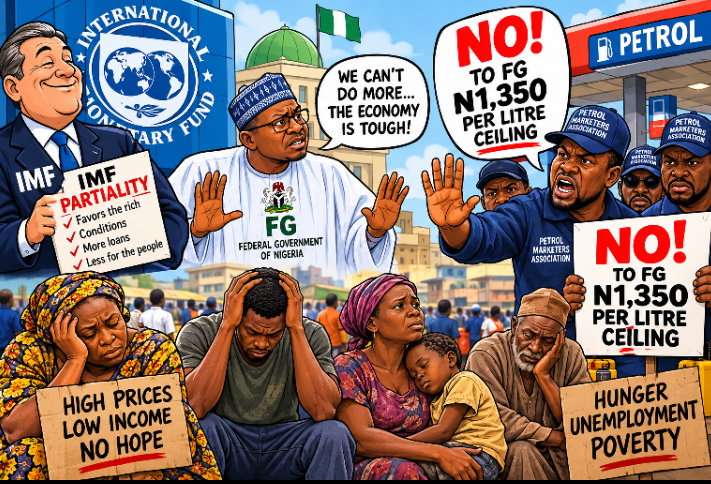
The Federal Government’s proposed ₦1,350-per-litre ceiling on petrol costs has exposed the contradictions in Nigeria’s management of the downstream petroleum sector. While the government seeks to moderate the impact of rising fuel prices, petroleum marketers have questioned the feasibility of arbitrary price caps, and the International Monetary Fund (IMF) has warned against restoring broad-based petrol subsidies. Caught in this policy dilemma are millions of Nigerians who continue to bear the consequences of rising transportation costs, expensive food, declining purchasing power and an increasingly difficult struggle for survival.
The Major Energies Marketers Association of Nigeria (MEMAN) has maintained that market forces, competition and improved distribution efficiency should determine prices in a deregulated petroleum market. Its position presents the Tinubu administration with an uncomfortable reality: government cannot proclaim deregulation, expect private operators to bear commercial risks and simultaneously assume that negotiations alone can deliver a price ceiling that satisfies both consumers and suppliers.
The Minister of Finance and Coordinating Minister of the Economy, Taiwo Oyedele, recently announced that the government was negotiating a ceiling of ₦1,350 per litre on petrol’s ex-gantry or landing cost. Under the proposed arrangement, refiners and importers would initially absorb costs exceeding the ceiling and recover the shortfall when market conditions improved. Although the government insists that the initiative is neither a subsidy nor price control, the distinction in terminology does little to resolve the fundamental questions surrounding its commercial viability.
Indeed, the government’s proposal appears to be an attempt to reconcile two competing objectives: maintaining market-driven petroleum pricing and protecting consumers from the consequences of rising energy costs. While both objectives are legitimate, their coexistence requires a credible mechanism that addresses the interests of suppliers without transferring the burden to consumers or creating new financial obligations for the government.
The first difficulty is the willingness of marketers to accept the arrangement. MEMAN has expressly rejected arbitrary price ceilings, arguing that transparent, market-driven pricing and measures to reduce operating costs would provide more sustainable solutions. Its position suggests that the government’s negotiations may encounter considerable resistance if the proposed ceiling prevents suppliers from recovering their costs and earning reasonable returns.
In a deregulated market, refiners, importers and marketers make commercial decisions based on prevailing costs, market opportunities and expected returns. International crude oil prices, exchange rates, freight charges, insurance, storage and distribution expenses all influence the final cost of petroleum products. Unless the government addresses these variables, asking operators to absorb the difference between actual costs and a politically acceptable benchmark may prove difficult to sustain.
MARKETERS’ RISK AND LOSS
The proposal also raises an important question: how long can private operators finance the government’s preferred price arrangement? Businesses cannot indefinitely absorb losses or defer the recovery of legitimate costs without consequences for their cash flow, investment plans and supply decisions. If the government expects refiners and importers to carry the burden temporarily, it must clearly establish how and when the shortfalls will be recovered.
Should the operators fail to recover those costs, the government must explain why private businesses should bear a public welfare obligation without compensation. If they eventually recover the shortfalls through subsequent price adjustments, consumers may face higher prices later. And if the government ultimately assumes responsibility for outstanding obligations, the arrangement could create contingent liabilities that Nigerians would eventually have to finance. These possibilities underscore the need for transparency before the initiative is implemented.
More importantly, the proposed ₦1,350 ceiling does not necessarily translate into a pump price of ₦1,350 per litre. The government is negotiating a ceiling on the ex-gantry or landing cost, not necessarily a final retail price. Transportation, storage, distribution expenses and retail margins remain relevant to the amount consumers pay at filling stations. Without a transparent formula linking the proposed ceiling to retail prices, the administration risks announcing a figure that sounds reassuring but delivers limited relief.
For Nigerians, the difference between a landing-cost ceiling and a pump-price ceiling is not an academic distinction. What matters to a commercial driver is the cost of filling a tank, while a commuter is concerned about transport fares. A trader wants to know whether the cost of moving goods will decline, and a household wants to know whether food prices will become more affordable. None of these concerns is answered merely by announcing a negotiated price benchmark.
Even if the government secures the agreement, a reduction in petrol prices may not automatically restore the purchasing power Nigerians have lost over the past three years. Food, rent, transportation, electricity, healthcare and education have become increasingly expensive. A temporary intervention that moderates further increases cannot, on its own, reverse the cumulative effects of inflation and declining real incomes. The government must therefore distinguish between slowing the rate of hardship and delivering genuine economic relief.
Rather than concentrating excessively on a single price ceiling, the administration should address the structural weaknesses that influence petroleum prices. These include foreign exchange exposure, logistics costs, storage infrastructure, competition, distribution inefficiencies and the availability of refined products. It should also ensure that domestic refineries operate within a competitive environment in which improved local production strengthens supply security without creating unrealistic expectations of automatically cheap petrol.
Nigeria’s growing domestic refining capacity offers an opportunity to reduce dependence on imported petroleum products and some associated costs. However, domestic refining does not automatically guarantee lower prices because refiners remain exposed to crude oil prices, financing expenses, exchange rates and alternative market opportunities. The government must encourage domestic production while allowing imports to bridge genuine supply gaps, rather than rely on administrative ceilings to conceal underlying cost pressures.
It is against this background that the IMF’s renewed opposition to broad-based petrol subsidies deserves closer examination. At the 2026 annual meetings of the IMF and World Bank in Bangkok, Thailand, Rodrigo Valdés, director of the fund’s Fiscal Affairs Department, argued that blanket fuel subsidies were fiscally expensive and often benefited higher-income consumers disproportionately. He recommended targeted assistance to protect vulnerable households, insisting that protecting people was not the same as protecting fuel prices.
There is merit in the IMF’s argument that indiscriminate subsidies can place considerable pressure on public finances and benefit consumers unevenly. However, the institution’s analysis appears incomplete when the consequences of subsidy removal are considered without equal scrutiny of the government’s management of the savings and the effectiveness of its replacement social protection measures. A policy cannot be declared successful merely because it reduces expenditure on one item of the national budget.
I begin to wonder lately whether the conscience of the IMF has been bought too by President Bola Tinubu and his administration, because its recent comments on fuel subsidy are obviously partisan in their practical implications. This is not an allegation that the institution has received money to influence its position; such a claim would require evidence. Rather, it reflects a growing concern that the IMF appears more interested in defending a policy direction embraced by the Nigerian government than in interrogating the failures that have made its consequences increasingly painful for ordinary citizens.
As an international financial institution, the IMF should provide objective economic assessments rather than appear to endorse the policy preferences of any government. Its responsibility is to examine the benefits, costs and limitations of competing approaches, taking into account the particular economic circumstances of each country. Its longstanding preference for subsidy removal should not become an inflexible doctrine that discourages legitimate debate about temporary relief, social protection and the accountability of governments.
Nobody is suggesting that the IMF should endorse reckless public expenditure or encourage governments to maintain unsustainable subsidies indefinitely. The issue is whether its advice adequately considers the institutional weaknesses, poverty levels and limited social protection capacity that shape the outcomes of economic reforms in Nigeria. An economic prescription that ignores these realities may appear sound in fiscal calculations while producing devastating consequences for the people expected to bear its costs.
The IMF’s argument that petrol subsidies are regressive also requires a more comprehensive assessment. Wealthier households generally consume more fuel directly and may therefore receive a greater absolute share of a general subsidy. Yet poorer households are affected by fuel prices through public transportation, food distribution, small businesses and the cost of essential services. Removing the subsidy consequently transmits higher costs throughout the economy, including to people who own no cars and consume little petrol directly.
The more important question, therefore, is not simply whether every Nigerian benefited equally from the former subsidy regime. It is whether the fiscal savings generated by its removal have been managed more effectively and whether the government has adequately protected those most vulnerable to the resulting price increases. The success of economic reform must be measured not only by savings to the treasury but also by its effects on household welfare, employment, productivity and poverty.
DID FUEL SUBSIDY FAIL TO DELIVER TO THE MASSES?
The more fundamental problem was the persistent failure of successive governments to address allegations of misappropriation, inflated claims, corruption and weak oversight within the subsidy system. Rather than confronting these weaknesses decisively, policymakers eventually treated the removal of the subsidy as the principal solution to a problem that also involved governance, transparency and accountability.
For years, Nigerians questioned the opacity of subsidy payments and the enormous sums reportedly committed to maintaining regulated fuel prices. Those concerns were legitimate and demanded urgent reform. But the existence of corruption within a subsidy regime does not prove that the entire policy offered no benefit to ordinary citizens.
Does removing it guarantee that the resources previously committed to it will be managed transparently or deployed more effectively.
The experience of the COVID-19 era under the administration of the late President Muhammadu Buhari provides an important lesson. During the pandemic, the government introduced palliatives and other interventions intended to cushion the economic consequences of the public health crisis. Yet, concerns about distribution, beneficiary selection and implementation raised questions about whether the assistance reached the people for whom it was intended. The announcement of relief did not guarantee that the relief would reach the vulnerable.
The IMF was not asleep during the COVID-19 era. It was aware of the extraordinary economic pressures confronting countries and the importance of protecting vulnerable populations. Nigeria’s experience nevertheless demonstrated that even well-intentioned interventions can fail when implementation is compromised, accountability is weak and public resources are diverted from their intended purposes. Citizens can remain hungry while assistance designed for their benefit is mismanaged.
The lesson from that period is that governments must be judged by the delivery of assistance, not merely by the amounts announced or allocated. Transparent beneficiary registers, verifiable disbursement records, independent monitoring and investigations into credible allegations of diversion are essential. Without these safeguards, palliatives risk becoming exercises in expenditure and publicity rather than effective instruments of social protection.
Unfortunately, similar concerns have persisted under Tinubu since the removal of petrol subsidy in 2023. The administration introduced measures intended to cushion the immediate consequences of higher fuel prices, including assistance for vulnerable households and interventions targeting affected sectors. However, widespread complaints about inadequate coverage and the limited impact of relief programmes have weakened public confidence in the government’s commitment to protecting citizens.
Not even a realistic proportion of the vulnerable population appears to have received assistance sufficient to offset the economic shock, let alone the wider masses who have also suffered from escalating living costs. The government may point to programmes and allocations, but Nigerians need verifiable evidence of their reach and effectiveness. A relief programme cannot be considered successful simply because it exists on paper or because money has reportedly been committed to it.
This is particularly troubling because one of the principal arguments for subsidy removal was that the savings would be redirected towards infrastructure, social protection and other productive investments. If the government has gained additional fiscal space, citizens are entitled to know how much has been saved, how much has been spent, which projects have benefited and what measurable improvements have followed. Nigerians should not be expected to endure prolonged hardship while the benefits of reform remain largely confined to official pronouncements.
The IMF should therefore scrutinise the management of subsidy savings with the same seriousness it applies to the fiscal cost of maintaining subsidies. It should ask whether the funds have been transparently accounted for, whether social programmes have achieved their objectives and whether the government has developed effective mechanisms to protect households against energy price shocks. To focus on the dangers of subsidies while paying insufficient attention to the failures of replacement measures is to offer an incomplete assessment of Nigeria’s economic challenges.
Targeted cash transfers, transport assistance, school feeding and support for vulnerable farmers are potentially more efficient ways of protecting disadvantaged households than subsidising every litre of petrol consumed. However, these measures require accurate beneficiary identification, reliable payment channels, effective monitoring and accessible complaint mechanisms. Nigeria cannot assume that targeted support will succeed merely because international experts recommend it.
The government must also recognise that vulnerability takes different forms. A rural farmer, an informal worker in an urban community, a low-income civil servant and a commercial driver may experience higher energy costs in different ways. Social protection must reflect these differences and avoid excluding people because they lack formal banking arrangements, reliable digital records or the documentation required by an imperfect beneficiary database.
Until these systems are demonstrably effective, the government should not dismiss every temporary price intervention as economically unacceptable. A carefully designed, transparent and time-bound measure may be justified during an extraordinary supply shock, provided its beneficiaries, costs, duration and exit conditions are clearly defined. The objective should be to protect vulnerable citizens without creating an open-ended fiscal obligation or undermining the commercial viability of petroleum supply.
The proposed ₦1,350 ceiling must consequently be supported by a clear implementation framework. The government should explain the formula used to determine the ceiling, the circumstances that would trigger its activation, the mechanism for reviewing it and the arrangements for recovering costs borne by refiners and importers. It should also disclose any financial obligations that could arise from the arrangement. Nigerians deserve more than assurances that a policy is neither a subsidy nor price control.
The administration must equally resist the temptation to turn the initiative into a political instrument ahead of the 2027 general elections. With some political actors advocating a return to petrol subsidy and the government defending its removal, economic policy risks becoming a contest of slogans. Whether an intervention is called price modulation, a discount, a subsidy or emergency relief matters less than who pays for it, who benefits and whether it can be sustained without creating larger economic problems.
PETROLEUM MARKETERS
At the same time, petroleum marketers must not use the difficulties associated with regulation as justification for opaque pricing or anti-competitive conduct. They should provide credible information about their costs and pricing decisions, while the Nigerian Midstream and Downstream Petroleum Regulatory Authority must enforce product-quality standards, ensure accurate measurement and promote fair access to petroleum products. Deregulation is not a licence for exploitation; it requires effective regulation that protects consumers without undermining legitimate commercial activity.
The government should also publish regular assessments of the impact of its energy policies on transportation, food prices, inflation and household welfare. Where an intervention fails to deliver the promised relief, it should be reviewed. Where public funds are committed, the expenditure should be auditable. Where officials or private operators abuse the system, there must be consequences. Public confidence will not be restored through repeated assurances but through measurable results and transparent institutions.
NLC NOT IN THE SAME PAGE WITH FG
The Nigeria Labour Congress has consistently criticised the hardship associated with subsidy removal, arguing that the policy has failed to deliver the promised benefits to workers and ordinary citizens. Its objections deserve serious consideration, even where its preferred remedies differ from those of the government or the IMF. Workers and low-income households are not obstacles to economic reform; their purchasing power, productivity and ability to meet basic needs are central to sustainable economic growth.
Likewise, economists who support subsidy removal are right to warn against the fiscal dangers of returning to an expensive and poorly governed system. However, support for reform should not become a refusal to acknowledge its shortcomings. A credible economic framework must permit evidence-based adjustments without automatically treating every temporary intervention as a retreat. The ultimate test is not whether a government remains ideologically consistent but whether its policies improve citizens’ welfare while preserving fiscal stability.
The Tinubu administration must therefore publish the full framework for the propos