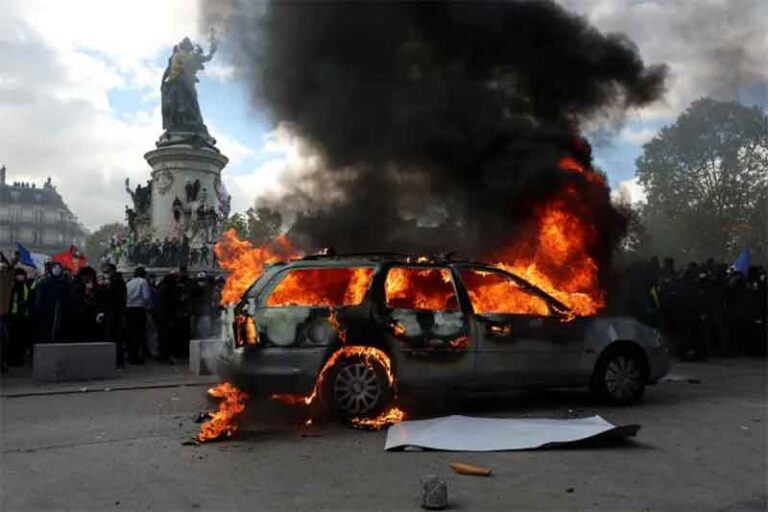
France is confronting a deepening social crisis as economic hardship, deteriorating public services and growing distrust of political leadership fuel weeks of demonstrations across the country.
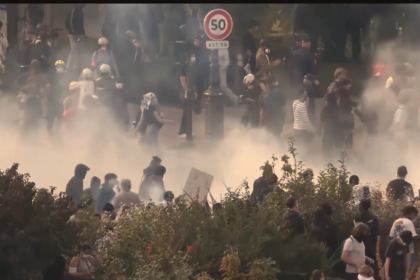
Interior Ministry said On October 31, approximately 320,000 people participated in protests nationwide, including 70,000 in Paris, meanwhile organisers estimated a higher turnout of around 500,000 though participation declined from previous demonstrations, the sustained mobilisation exposes a troubling divide between the government’s economic priorities and the everyday struggles of ordinary citizens.
The latest demonstrations marked the third consecutive weekend of nationwide mobilisation in which authorities recorded 550,000 participants on October 17 and 410,000 on October 24, before turnout fell to 320,000 on October 31. The declining figures may suggest that the movement is losing some momentum, but they do not erase the grievances driving it. However, a government would be mistaken to interpret fewer demonstrators as proof that public anger has disappeared.
The Interior Ministry reported 779 arrests during the October 31 demonstrations and the subsequent Halloween night. At 9 p.m., 565 arrests had been recorded, alongside 116 injured members of the security forces. The ministry also reported 515 fires dealt with, 36 businesses damaged and three shops looted. These figures demonstrate the seriousness of the disorder, but arrests must not be confused with convictions, and the actions of violent individuals must not be used to discredit everyone participating in peaceful demonstrations.
One particularly disturbing incident occurred in Paris, where a gendarme was struck by a petrol bomb that set his protective clothing alight. Authorities opened an investigation into suspected attempted murder. The officer reportedly sustained relatively minor injuries despite the frightening nature of the attack. Such violence is indefensible. No economic grievance, however legitimate, can justify deliberately setting another human being on fire. Those responsible should face due process and appropriate punishment.
Nevertheless, condemning violence must not become an excuse for ignoring the reasons people are protesting. The demonstrations began amid complaints about inadequate school facilities and teacher shortages before expanding into broader concerns about living costs, purchasing power and public services. When students, workers and families mobilise around interconnected grievances, the government must recognise that the crisis extends beyond public order. Arresting offenders may restore temporary calm, but only credible reforms can address the underlying discontent.
Education has emerged as one of the movement’s central concerns as students and teachers have complained about overcrowded classrooms, inadequate school facilities, shortages of teachers and difficulties replacing absent educators. These problems directly affect the quality of learning and the opportunities available to young people. In a wealthy country such as France, persistent deficiencies in public education raise legitimate questions about the allocation of national resources and the government’s commitment to equal opportunity.
A public education system should give children a reasonable chance to succeed regardless of their parents’ income or where they live but when disadvantaged communities face weaker facilities and insufficient teaching support, inequality becomes entrenched from an early age. The consequences extend beyond individual classrooms, affecting employment prospects, social mobility and confidence in public institutions.
A government that claims to defend equality must demonstrate that commitment through functioning schools, adequate staffing and measurable improvements in educational outcomes.
The concerns also extend to higher education, where the Parcoursup admissions system has attracted criticism over uncertainty and access to preferred courses.
For young people, education represents more than academic achievement; it is often their principal route towards financial independence and a better future. When students face uncertainty over admission, housing and the affordability of university life, frustration is understandable, policymakers must ensure that educational opportunities are accessible, transparent and supported by adequate student assistance.
The cost-of-living crisis has widened the movement beyond schools and universities. Housing, food, transport and energy expenses continue to place pressure on household budgets, particularly among lower-income families. Workers who rely on cars to reach their jobs are especially vulnerable when fuel costs rise and affordable public transport is unavailable.
Families should not have to choose routinely between paying rent, buying groceries and meeting other essential expenses. French President Emmanuel Macron should know that economic policy loses credibility when national ambitions coexist with growing anxiety over basic necessities.
These grievances recall the Yellow Vest movement that began in 2018, when fuel taxation and declining purchasing power triggered a wider revolt against perceived economic injustice.
The protests exposed resentment among working people who believed they were being asked to shoulder disproportionate costs while wealthier groups enjoyed greater financial security.
The lesson remains relevant: policies that appear economically defensible on paper can become politically disastrous when citizens believe their burdens are unfairly distributed.
France’s 2023 pension reform produced a similar confrontation when the government raised the statutory retirement age from 62 to 64, arguing that reform was necessary to maintain the financial sustainability of the pension system.
Meanwhile, opponents argued that workers, particularly those in physically demanding occupations, would bear an unfair burden. The controversy demonstrated that reforms affecting millions of people cannot be sustained by financial arguments alone as governments must also consider fairness, public consent and the real conditions under which people live and work.
France’s fiscal challenges cannot simply be dismissed. Public debt and budget deficits constrain government choices, while pressure to reduce borrowing complicates demands for additional spending yet fiscal discipline should not become a justification for weakening essential public services.
Cutting educational support, healthcare provision or social protection may deliver immediate savings while imposing greater long-term costs through inequality, reduced productivity and social instability. The real test of responsible economic management is whether a government can control expenditure without undermining the foundations of social welfare. This is obviously where Macron’s government seems failing the people.
The debate over defence spending raises another important question when France has substantial military commitments and long-term defence investment plans, reflecting its international responsibilities and security concerns.
However, citizens are entitled to ask how national priorities are determined when schools face shortages and public services struggle to meet demand. Defence and education budgets serve different purposes and operate over different periods, so direct comparisons require caution, nevertheless, genuine national security must encompass not only military capability but also an educated population, reliable healthcare and social cohesion.
Police conduct has become another source of tension. The state has a responsibility to prevent violence, protect businesses and safeguard the public, being why the right to peaceful protest must also be protected.
Authorities should distinguish clearly between demonstrators exercising their civil liberties and individuals committing offences. Treating an entire movement as criminal because some participants engage in violence risks deepening resentment, undermining confidence in democratic institutions and questioning freedom of expression.
The reported attack on the gendarme illustrates the dangers facing security personnel during violent confrontations. Officers must be able to perform their duties without being targeted with petrol bombs, stones or other potentially lethal weapons. Equally, law-enforcement agencies must use force proportionately and remain accountable for misconduct. Protecting police officers and protecting citizens’ rights are not competing objectives. Both are essential to a functioning democracy, and neither should be sacrificed to political expediency.
France’s experience following the 2023 police killing of 17-year-old Nahel Merzouk remains relevant to the current debate. His death triggered nationwide unrest and renewed scrutiny of policing, discrimination and public trust, particularly among young people in disadvantaged communities. The episode demonstrated how quickly an individual incident can expose deeper tensions between communities and law-enforcement institutions.
Therefore transparent investigations and consistent accountability are indispensable if the public is to trust that the law applies equally to everyone.
The political consequences are equally serious. President Emmanuel Macron’s government faces pressure to demonstrate that its economic reforms can deliver tangible benefits beyond investment figures and national competitiveness but critics argue that policies affecting pensions, labour and public expenditure have placed excessive pressure on ordinary people, supporters maintain that difficult reforms are necessary to modernise the economy. Whatever the merits of these arguments, the protests indicate that economic policy cannot be judged solely by its intentions; its social consequences matter just as much.
France’s fragmented political landscape further complicates the response. Following the 2024 snap legislative elections, Macron’s political camp lost its absolute majority in the National Assembly, making parliamentary compromise more difficult. Disputes over budgets and public spending have intensified political uncertainty yet political fragmentation is not necessarily a democratic failure. The greater danger arises when competing parties prioritise electoral advantage over practical solutions to the problems confronting citizens.
The confrontation has also become entangled in the wider struggle between the political left and right. Left-wing parties have emphasised inequality, purchasing power and the protection of public services, while right-wing movements have stressed law and order, immigration and state authority. Both approaches deserve scrutiny based on their policies and evidence. Political labels cannot substitute for serious debate about employment, taxation, education and social welfare nor should legitimate criticism of government policy automatically be portrayed as hostility towards the state.
The rise of political polarisation creates additional risks. When governments dismiss protesters as extremists and opponents portray every government action as repression, opportunities for constructive dialogue narrow. The public is left with increasingly hostile political narratives rather than convincing solutions. France needs leaders willing to acknowledge legitimate grievances without excusing violence and willing to enforce the law without suppressing peaceful dissent.
Tensions in the Middle East, including conflicts involving Israel, Iran and the United States, can disrupt energy markets and increase uncertainty over international trade. The Strait of Hormuz is particularly important because of its role in global energy transportation.
However, Governments should be judged consistently against international law, regardless of their geopolitical alliances.
France’s experience offers important lessons for countries such as Nigeria, where citizens also face concerns about purchasing power, employment, education and the reliability of public services.
Economic growth and infrastructure investment are important, but their benefits must translate into better living conditions for ordinary people. A government cannot rely indefinitely on impressive economic announcements if households struggle to afford food, transport, housing and education. Public confidence depends on whether people can experience meaningful improvements in their daily lives.
The government must now move beyond statements of concern and demonstrate a credible commitment to reform by improving school facilities, recruiting sufficient teachers, supporting disadvantaged students and addressing household economic pressures, among others.
Authorities should also investigate allegations of police misconduct transparently and prosecute individuals responsible for violence through due process. Clear targets, public reporting and meaningful engagement with students, teachers, workers and families would provide stronger evidence of progress than another round of political promises.
France’s crisis is a test of whether its political leadership understands the difference between controlling unrest and resolving the conditions that produce it. The government cannot arrest its way out of poverty, police its way out of educational decline or restore public confidence through promises unsupported by action.