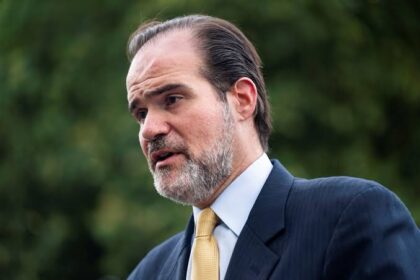
The founder of embattled Chinese property giant Evergrande, Hui Ka Yan, has been sentenced to life imprisonment over multiple financial crimes, marking a dramatic fall from grace for one of China’s former wealthiest businessmen.
Hui, also known as Xu Jiayin, pleaded guilty in April to charges linked to his tenure as chairman of Evergrande, including financial fraud and misuse of funds.
A court in the southern Chinese city of Shenzhen handed down the sentence on Thursday, according to state-run Xinhua news agency. Hui was also ordered to forfeit his personal assets and stripped of his political rights.
Evergrande Group was fined 8.82 billion yuan, equivalent to about $1.23 billion, while its subsidiary, Evergrande Real Estate, was fined seven billion yuan.
The companies and Hui were found guilty of several offences, including financial fraud, inflating assets and concealing liabilities, illegally absorbing public deposits, fundraising fraud and the illegal disclosure of important information.
The verdict described the conduct of Hui and the companies as having seriously disrupted China’s socialist market economy and violated public and private property rights.
The punishment brings another major development in the collapse of Evergrande, whose debt crisis emerged in 2021 and became one of the most prominent symbols of China’s prolonged property-sector downturn.
Evergrande accumulated liabilities estimated at around $300 billion, leaving the company struggling to complete projects and meet obligations to creditors, investors and other stakeholders.
At its peak, Evergrande employed about 200,000 people, recorded more than $110 billion in annual sales and controlled over 1,300 property developments across more than 280 Chinese cities.
The company also expanded beyond real estate, including through its ownership of Guangzhou Evergrande football club, which won major domestic and Asian honours during China’s property boom.
Hui’s rise had once been viewed as a classic rags-to-riches story. Born in Henan province in the late 1950s, he was raised by his paternal grandmother and worked on a farm and later as a security guard.
He eventually studied metallurgy at the Wuhan Institute of Iron and Steel before beginning his career at a steel mill. In 1992, he moved to Shenzhen with savings of about 20,000 yuan to pursue opportunities in the property sector.
Four years later, Hui founded the company that would become Evergrande. The developer expanded rapidly as China’s economy and housing market underwent decades of extraordinary growth.
At the height of the boom, real estate and related industries accounted for as much as 30 percent of China’s economic output, with developers relying heavily on borrowing to finance large-scale housing projects.
However, excessive debt, slowing property demand and an oversupply of housing eventually exposed deep weaknesses across the sector. The resulting crisis has left unfinished developments and empty housing projects in several parts of China.
The downturn has also weakened consumer confidence and created wider economic challenges for Beijing. Official data showed that new home sales fell to their lowest value in 2014 last year, standing at about 7.3 trillion yuan, compared with 16.2 trillion yuan in 2021.
Despite a series of government measures aimed at supporting the property market, China’s housing crisis continues to weigh on the economy. Hui’s life sentence therefore represents not only the downfall of a once-powerful business tycoon, but also a stark reminder of the risks that accompanied China’s extraordinary property boom.