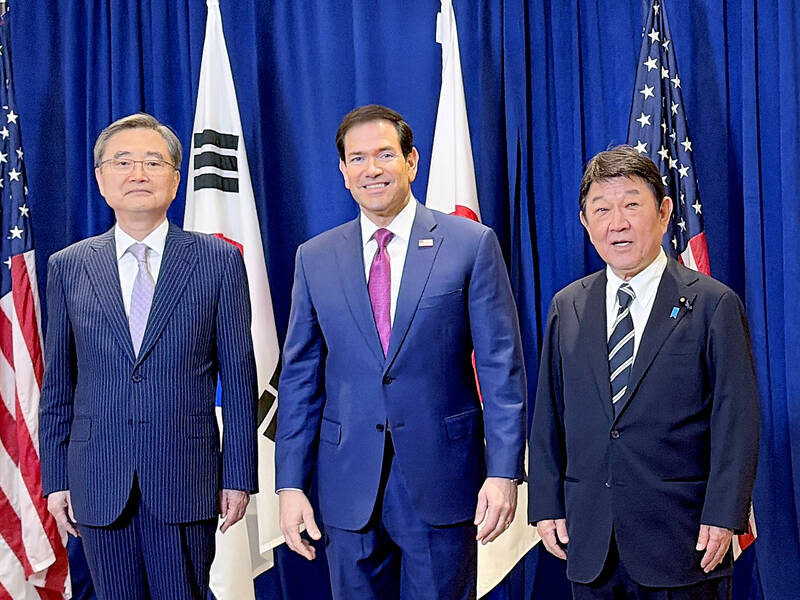
The United States has reaffirmed its defence commitments to Japan and South Korea, while Washington, Tokyo and Seoul jointly expressed support for Taiwan’s meaningful participation in appropriate international organisations amid heightened geopolitical tensions in the Indo-Pacific.
The development is significant because it comes just ahead of a highly anticipated meeting between US President Donald Trump and Chinese President Xi Jinping in Washington, with growing concerns among America’s Asian allies that economic negotiations with Beijing could involve compromises on sensitive security issues, particularly Taiwan. Such concerns underline the delicate balance Washington faces between pursuing economic cooperation with China and reassuring partners whose security interests are closely tied to US policy.
US Secretary of State Marco Rubio held talks with South Korean Foreign Minister Cho Hyun and Japanese Foreign Minister Toshimitsu Motegi in New York on Monday.
Following the meeting, the three ministers issued a joint statement pledging to strengthen cooperation against what they described as “economic coercion and non-market policies and practices,” as well as arbitrary export restrictions capable of disrupting global supply chains.
The ministers also welcomed the establishment of a new trilateral consultation mechanism on economic security, designed to deepen cooperation on supply chains, critical technologies and other areas considered strategically important.
On defence, Washington reiterated what it described as its “ironclad commitments” to the defence of Japan and the Republic of Korea, backed by US military capabilities, including its nuclear forces.
The statement also reaffirmed America’s extended-deterrence commitments to both countries, signalling Washington’s continued intention to provide security assurances to its major Northeast Asian allies.
The three foreign ministers further emphasised the importance of maintaining peace and stability across the Taiwan Strait, while expressing support for Taiwan’s meaningful participation in appropriate international organisations.
The statement is particularly notable because Taiwan remains one of the most sensitive issues in US-China relations, with Beijing opposing moves it considers to give Taiwan greater international recognition.
The ministers also reaffirmed their commitment to the complete denuclearisation of North Korea and urged Pyongyang to return to dialogue, highlighting the broader security concerns shared by the three countries.
In Taipei, Presidential Office spokeswoman Karen Kuo said yesterday that peace and stability across the Taiwan Strait and the wider region represented an important international consensus and a foundation for global security and prosperity.
Kuo welcomed the joint efforts by the three countries, saying their actions demonstrated a commitment to regional stability and cooperation.
She added that democratic partners must work together to uphold what she described as the rules-based international order amid a rapidly changing geopolitical environment.
Kuo further said Taiwan remained committed to maintaining regional peace and acting as a responsible international actor.
Separately, Taiwan’s Ministry of Foreign Affairs spokesman Hsiao Kuang-wei said stability across the Taiwan Strait was closely connected to the security of the Indo-Pacific as well as the global economy and international supply chains.
Hsiao said the reaffirmation by Washington, Tokyo and Seoul demonstrated the growing international emphasis placed on peace and stability in the Taiwan Strait.
He added that Taiwan would continue strengthening its self-defence resilience and maintaining the existing “status quo” across the Strait.
Taipei also said it would deepen cooperation with the United States, Japan, South Korea and other democratic partners to promote peace, stability and prosperity across the Indo-Pacific.
The immediate challenge, however, remains the extent to which the Trump administration can pursue improved economic relations with Beijing without creating uncertainty among its Asian allies. With the Trump-Xi meeting approaching, statements of support for Japan, South Korea and Taiwan provide reassurance, but the substance of US-China negotiations will ultimately determine how those assurances are interpreted across the region.