The United States has threatened to impose secondary sanctions on global aviation service providers that continue to deal with Iranian airlines, raising concerns about the ability of carriers from Tehran to maintain international operations.
US Treasury Secretary Scott Bessent said on Monday that Iranian airlines could effectively be “shut down” from September 23 if companies and airports providing services to them face the threat of being cut off from the US dollar financial system.
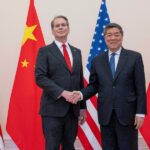
Bessent made the remarks to CNBC after concluding talks with Chinese Vice Premier He Lifeng on Sunday 20th September 2026 as Washington intensifies its economic pressure campaign against Iran.
Under the proposed measures, aviation companies and airports could face sanctions for providing Iranian carriers with essential services, including aviation fuel, landing facilities and ticketing arrangements.
“When Iranian airlines land at an airport, you cannot provide them with fuel, you cannot provide them with landing services, you cannot sell them tickets, or you will be knocked out of the dollar system,” Bessent said.
The Treasury secretary also indicated that Washington was holding what he described as positive discussions with Chinese financial authorities over compliance with US sanctions targeting Iran.
Iran operates several international airlines, including Iran Air, Mahan Air and Qeshm Air thought their presence in the global aviation market remains relatively limited compared with major international carriers.
Saj Ahmad, chief analyst at StrategicAero Research, said the limited international footprint of Iranian airlines could restrict the overall impact of the proposed sanctions.
Ahmad questioned whether airports would be willing to reject revenue from Iranian carriers and how Washington would monitor and enforce restrictions across the numerous companies involved in airport operations.
He identified aviation fuel, landing charges, aircraft parking and ground-handling services—including passenger, cargo, water and sanitation services—as some of the major areas potentially affected by the measures.
According to Ahmad, enforcing the restrictions could prove particularly difficult in countries such as Pakistan and China, which maintain strong economic and diplomatic ties with Iran.
“Therefore, it’s hard to see who will play ball and just how the US will enforce this if people simply ignore these demands,” he said.
The threatened aviation measures form part of Washington’s wider economic campaign against Tehran, which the Trump administration has described as an effort to restrict Iranian sources of revenue and international financial access.
Bessent said last week that the Treasury Department would continue targeting individuals and organisations accused of providing material, technological or financial support that enables the Iranian government to sustain what Washington describes as its terrorist activities.
Last month, the Treasury Department also expanded its secondary sanctions campaign, warning that financial institutions and other entities continuing to conduct business with Iran could lose access to the US dollar system.
For Iranian aviation, the consequences could nevertheless be significant if international airports, fuel suppliers and ground-service companies comply with the American restrictions.
Ahmad said the measures would hamper Iranian airline operations despite the carriers’ already limited international reach, potentially leaving Iran increasingly isolated from international air travel.
He added that Iran could become more dependent on foreign airlines for international connectivity if its own carriers encounter growing difficulties obtaining essential services abroad.
The immediate challenge for Washington, however, will be enforcement. Unlike financial transactions that can be tracked through international banking networks, aviation operations involve airports, fuel companies, ground handlers, ticketing agents and other service providers spread across different jurisdictions.
The effectiveness of the sanctions may therefore depend not only on the strength of the US threat but also on the willingness of countries where Iranian airlines operate to comply with Washington’s demands.
With the September 23 deadline approaching, the aviation industry is watching closely to determine whether the threatened measures translate into widespread restrictions or encounter resistance from countries that maintain commercial and strategic ties with Tehran.