The deaths of 37 suspected illegal miners in the custody of the Nigeria Security and Civil Defence Corps (NSCDC) in Minna, Niger State, have triggered investigations, official suspensions and renewed scrutiny of illegal mining, poverty and conditions in government detention facilities.
The victims were among scores of people arrested during NSCDC operations around the M.I. Wushishi/Lukoto Village mining axis in Minna on September 15 and 16. The circumstances surrounding their deaths remain under investigation, with authorities examining issues including overcrowding, ventilation, possible exposure to substances and the medical condition of the detainees.
The Niger State Government has since inaugurated a nine-member Judicial Commission of Inquiry headed by Justice Muhammad S.A. Muhammad of the Niger State High Court. Governor Mohammed Umaru Bago said the commission has four weeks to complete its assignment and submit its findings.
The NSCDC has also suspended its Niger State Commandant, Suberu Siyaka Aniviye, and members of his team to allow investigations to proceed. The police, DSS and NSCDC have commenced separate investigations, while forensic examinations and autopsies are expected to help establish the definitive cause of death.
The immediate government response has, however, drawn criticism from the Movement for a Socialist Alternative (MSA), which argued that suspending or arresting individual officers would not address what it described as the deeper institutional failures behind the tragedy.
According to the MSA, the government should be held accountable for the conditions under which people arrested for alleged illegal mining were detained. The group also called for the arrest and prosecution of individuals it described as the major beneficiaries of illegal mining, rather than focusing primarily on the workers found at mining sites.
The group argued that poverty and unemployment are central to understanding why people, including teenagers, continue to enter mining pits despite the dangers involved.
A report by Daily Post illustrates the problem through the experience of 15-year-old Musa, who said he began mining at about 10 and later dropped out of school because his family could not afford his education.
Musa said he wanted to return to school but had no money to do so. Other young miners interviewed in Niger State similarly described mining as a means of supporting themselves and their families.
An 18-year-old miner, Kudu, said mining had become a family activity, with his mother and siblings also involved. Another miner, Muhammad, said he would return to the pits after his release because he had no other source of income.
Fourteen-year-old Hassan, whose family reportedly moved from Kano to Minna, said he had not returned to school since arriving in the state and had spent about two years mining.
The reports suggest that enforcement alone has struggled to break the cycle. Some miners told newsmen that they had previously been arrested but returned to the sites after their release because they had no alternative livelihood.
There are also allegations surrounding payments for the release of arrested miners. Some miners claimed that amounts as high as N500,000 were demanded for bail though they said negotiations could reduce the amount to between N15,000 and N25,000. Two parents separately claimed they paid N500,000 while trying to secure the release of their children.
Those allegations could not be independently established. Daily Post reported that it could not determine who received the money, the legal basis for the payments or whether the alleged payments represented authorised bail charges. The NSCDC was contacted for clarification but had not responded before the report was published.
The issue of repeated arrests has also been acknowledged by security authorities. Niger State Police spokesperson Wasiu Abiodun previously described the repeated arrest and return of illegal miners to mining sites as “recycling them.”
What happened inside the cell?
The exact circumstances surrounding the deaths remain unresolved.
The NSCDC initially attributed the deaths to a suspected outbreak of disease while stressing that the cause had not been conclusively established. The state government subsequently ordered investigations.
One surviving detainee, Dauda Shehu, reportedly said 65 people had been held in a poorly ventilated cell. Another survivor alleged that detainees were subjected to extreme heat and that requests for the cell door to be opened were refused.
A further allegation emerged when a survivor told authorities that a substance smelling like perfume had been sprayed inside the cell before the door was locked. He said the substance caused a burning sensation in the eyes and throat.
These accounts remain allegations and are among the issues investigators are expected to examine.
Governor Bago said preliminary investigations were considering possibilities including overcrowding, suffocation and exposure to substances associated with mining. He stressed that these were preliminary observations rather than a final determination of the cause of death.
The bodies were deposited at the General Hospital, Minna, for clinical examination and laboratory tests. The hospital’s medical director, Dr Mohammed Danasabe, said 37 bodies were registered and that the same number was subsequently transported for burial.
Conflicting claims about the death toll have also circulated, but the official figure released by the Niger State Government remains 37.
Illegal mining and poverty
The tragedy has also revived questions about Nigeria’s mineral wealth and the informal economy surrounding it.
The MSA argued that Nigeria’s mineral resources should be brought under public ownership and management, while accusing powerful beneficiaries of illegal mining of exploiting poor workers.
The organisation called for the government to end illegal mining, bring mining operations under public ownership, improve wages and working conditions, and prosecute those who profit from illegal extraction and export of the country’s mineral resources.
It also linked illegal mining to wider security challenges in northern Nigeria.
The argument comes against a background in which gold, tin, lithium, iron ore, uranium and other minerals are mined across parts of northern Nigeria. However, the existence of extensive mineral resources has not translated into secure livelihoods for many communities where informal mining has become a source of income.
The experiences documented in Niger State point to a difficult policy dilemma: authorities want to stop illegal mining because of its environmental, security and regulatory consequences, but many people involved in the activity depend on it for their daily survival.
Mining returns after the deaths
The dependence became evident again when TheCable visited the M.I. Wushishi mining site on September 20.
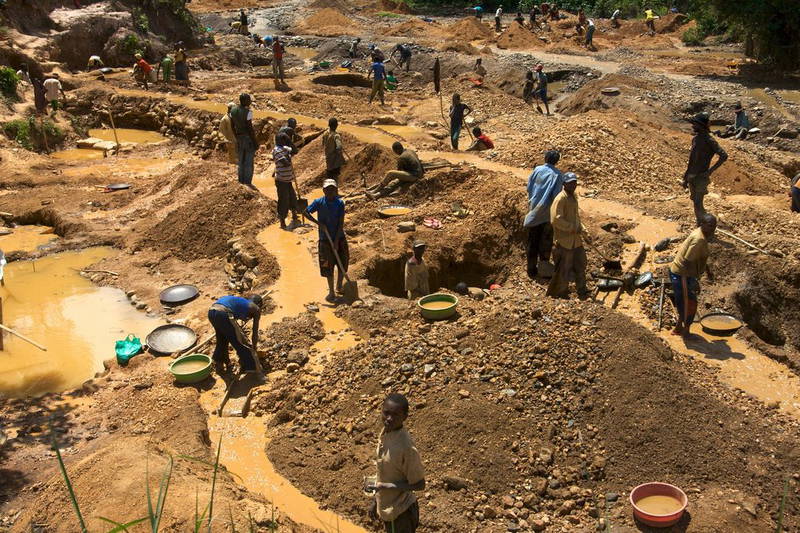
The report said teenagers, adults and women had returned to the site and resumed mining despite the deaths of 37 people who had been arrested there days earlier.
The miners reportedly used shovels, picks and other hand tools to dig and process gold-bearing soil. No security personnel were seen at the site during the visit.
One miner, Salisu DanMallam, said he stayed away from the site for several days because of the NSCDC operation but subsequently returned.
The development illustrates the difficulty of relying exclusively on raids and arrests to eliminate illegal mining. For people who regard mining as their only source of income, enforcement may temporarily remove them from the pits without removing the economic conditions that brought them there.
Protests and government response
The deaths triggered protests in parts of Minna, with residents reporting disruption to commercial activities and movement.
According to report, the unrest reportedly spread from areas around M.I. Wushishi and other parts of the city. Public property was damaged, including vehicles at a Niger State Transport Authority facility.
The state government subsequently imposed a six-hour curfew on Minna.
Inspector-General of Police Rilwan Disu visited Governor Bago and pledged that the circumstances surrounding the deaths would be thoroughly investigated. He also appealed for calm and warned residents against taking the law into their own hands.
Former military Head of State Ibrahim Badamasi Babangida also condemned the deaths and urged affected families and youths to allow investigations to proceed.
The Niger State House of Assembly has called for a thorough and transparent investigation, including examination of the condition of detainees at the time of arrest, the number detained, duration of detention, conditions inside the facility, medical attention provided and the definitive cause of death.
Atiku demands accountability
Meanwhile, Former Vice-President Atiku Abubakar has also criticised the government’s response, arguing that responsibility should extend beyond the officers who have been suspended.
Atiku, through his spokesperson Phrank Shaibu, said the deaths of 37 Nigerians arrested by government agents must not be allowed to disappear behind official statements or the suspension of junior officers.
He argued that because the victims were alive when they entered government custody, the authorities had a responsibility to account for what happened to them while they were detained.
Atiku also compared the incident with the 2014 Nigeria Immigration Service recruitment exercise at the National Stadium in Abuja, during which at least 16 people died, and questioned whether similar standards of accountability should apply.
His comments have added a political dimension to the growing debate over responsibility for the deaths.
Beyond the investigation
The judicial inquiry now faces the task of establishing what happened inside the NSCDC facility and determining whether negligence, overcrowding, inadequate medical attention, exposure to harmful substances or other factors contributed to the deaths.
But the broader crisis extends beyond the immediate circumstances of September 17.
Niger State’s mining communities demonstrate how poverty, unemployment, inadequate educational opportunities and weak regulation can sustain illegal economic activities despite repeated enforcement operations.
Musa wants to return to school but says his family cannot afford it. Muhammad says he intends to return to mining because he has no alternative source of income. Other young people also interviewed by newsmen similarly described mining as a means of survival.
The government therefore faces two connected challenges: enforcing mining laws while addressing the economic conditions that continue to push young people into dangerous and unregulated work.
At the same time, the deaths have raised a fundamental question about the treatment of people in government custody. Regardless of whether the detainees were involved in illegal mining, the circumstances of their detention and deaths require a transparent determination based on evidence.
The outcome of the judicial commission, police investigation, NSCDC inquiry, forensic examinations and autopsies will be central to answering those questions.
For the families of the 37 victims, however, the investigation is not merely about policy or enforcement, it is about establishing how their relatives entered government custody alive and why they did not return home.