The United States is pushing for the international adoption of the term “super intelligence” in place of “artificial intelligence,” seeking to extend President Donald Trump’s preferred terminology to global economic institutions and international technology discussions.
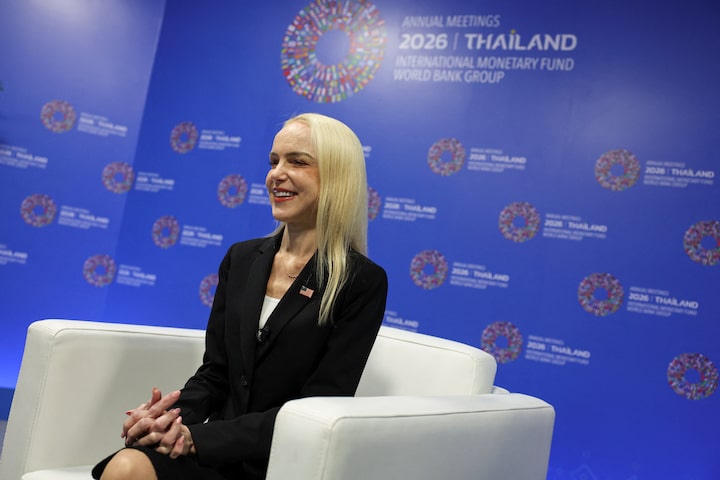
US Treasury Under Secretary for International Affairs Erin Browne disclosed this on Thursday during an interview with Reuters at the 2026 Annual Meetings of the International Monetary Fund (IMF) and the World Bank in Bangkok, Thailand.
Browne said Washington was negotiating with other shareholders of the IMF to incorporate the proposed terminology into a statement being prepared by the International Monetary and Financial Committee (IMFC), the fund’s steering committee.
The move follows a directive issued by Trump last month instructing US government agencies to use “super intelligence,” abbreviated as SI, instead of “artificial intelligence,” or AI, when referring to the technology.
According to Browne, the United States believes the alternative expression better captures the nature and potential of the rapidly developing technology.
“President Trump has been really clear on this, and he’s, you know, using the term SI, and I think it’s a clear priority for the US to use that term, and we think that more appropriately encapsulates the technology at hand,” she told Reuters.
The push reflects Washington’s broader ambition to influence international standards and discussions surrounding emerging technologies, particularly as governments increasingly view artificial intelligence as a driver of economic growth and productivity.
The United States currently holds the rotating presidency of the Group of 20 major economies and wants the proposed terminology to gain acceptance beyond its domestic institutions.
However, the initiative has reportedly raised concerns among some members of the IMFC, with a source familiar with the discussions telling Reuters that US officials had suggested they would insist on the new wording during negotiations over the committee’s statement.
Browne declined to say whether Washington would withhold its approval of the statement if other members rejected the proposed change, stressing that negotiations remained ongoing.
“We’re still in the middle of negotiations on that statement, so I’m not going to, you know, sort of run ahead of that,” she said.
The disagreement could complicate efforts to produce a consensus statement reflecting the views of IMF members on the global economy and other major financial and policy issues.
If the United States refuses to support a joint statement, the current IMFC chair, Saudi Finance Minister Mohammed Al-Jadaan, could instead issue a chair’s statement summarising members’ positions.
Another option under consideration is to avoid using either “artificial intelligence” or “super intelligence” and refer to the technology more broadly as “new technology,” according to the source.
The IMFC is expected to hold a news conference and release any agreed statement on Saturday, with Al-Jadaan and IMF Managing Director Kristalina Georgieva leading the announcement.
Beyond the terminology dispute, Washington has emphasised the technology’s importance to economic expansion, arguing that developments in the field could strengthen productivity in the United States and internationally.
“We see this as a driving force behind American growth and global growth,” Browne said.
She added that many countries were looking to the United States to establish standards and shape the direction of technological development.
“Many countries are looking to the US to set the standards, as well as to set the path forward for SI development and how that can really enhance and boost growth and productivity on a global basis,” she said.
The proposed change, however, raises questions about whether replacing an established technical term with a politically preferred alternative will gain broad international acceptance.
Artificial intelligence is the widely used term for technologies that perform tasks associated with human intelligence, including language processing, pattern recognition and decision-making. Superintelligence, by contrast, is commonly used in technology discussions to describe a hypothetical or emerging form of intelligence that substantially surpasses human cognitive capabilities.
The terms are therefore not necessarily interchangeable in established technical usage, making the proposed shift potentially significant for international communication and policy discussions.
Whether Washington can persuade other economies to adopt its preferred terminology will become clearer as negotiations continue ahead of Saturday’s announcement.