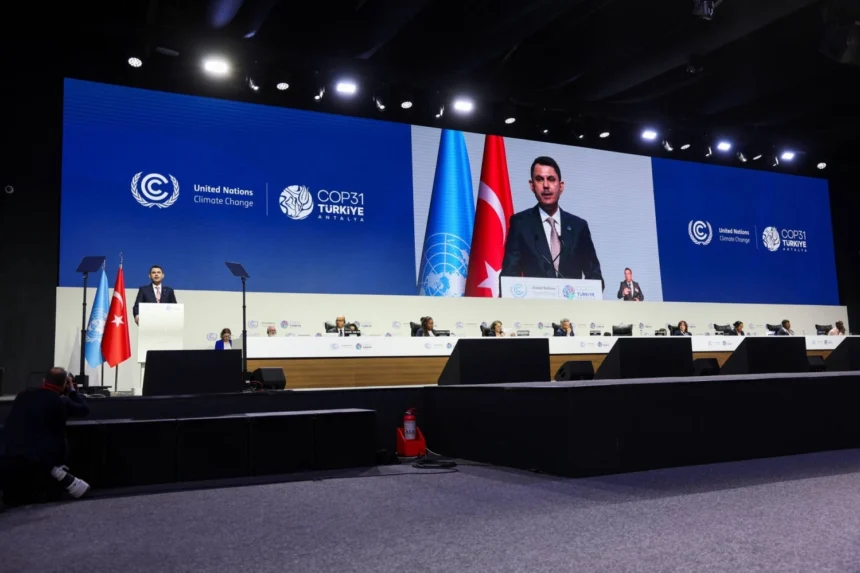
Japan is using the ongoing 31st United Nations Climate Change Conference (COP31) in Antalya, Turkey, to showcase its advanced environmental technologies, as world leaders push to increase global electrification to 35 per cent by 2035.
The conference, which opened on Monday and runs until November 20, is expected to attract about 90,000 delegates from 200 countries.
Although Japanese Prime Minister Sanae Takaichi will not attend, her government is seeking to use the global gathering to promote technologies that could contribute to the transition towards cleaner energy.
Turkey, the host country, has proposed a collective global target of increasing electricity’s share of final energy consumption from just over 20 per cent currently to 35 per cent by 2035.
The proposed target is based on analyses by the International Energy Agency and the International Renewable Energy Agency. It is intended to accelerate the implementation of the Paris Agreement and keep global warming within the 1.5-degree Celsius threshold above pre-industrial levels.
At the Environment Ministry’s Japan Pavilion, the country is highlighting technologies developed by Japanese companies to advance electrification, including perovskite solar cells, which are considered a promising alternative to conventional solar panels.
Unlike traditional solar cells, perovskite cells are lightweight and flexible, making them suitable for installation in locations where conventional solar panels may be difficult to deploy.
Japan is strategically positioned to benefit from the technology, as it accounts for approximately 30 per cent of global iodine production. Iodine is a primary material used in manufacturing perovskite solar cells, making the technology an important component of Japan’s future energy strategy.
Kenichiro Yamaguchi of the Mitsubishi Research Institute said the development could create opportunities for Japan to gain ground in the global solar energy market, currently dominated by China.
“While conventional solar power generation is almost entirely dominated by China, I think the focus will shift to advanced technologies such as perovskite,” he said.
Other technologies being promoted by Japan at the conference include energy conservation systems, carbon capture and storage, and waste reduction solutions.
Japan’s delegation is being led by Environment Minister Hiroyoshi Sasagawa, following Takaichi’s decision to skip the conference for the second time, citing a busy domestic schedule, including parliamentary deliberations on a tax-cut bill.
Her absence also marks the third consecutive year that a Japanese prime minister has not attended the climate summit.
Chief Cabinet Secretary Minoru Kihara told reporters on Monday that only three Japanese prime ministers had participated in the global climate conferences over the past three decades.
Yamaguchi, however, noted that prime ministerial attendance at the summits had historically been uncommon, with environment ministers typically leading Japan’s negotiating teams.
He explained that when a prime minister attends, the conference often takes on a broader diplomatic dimension beyond climate negotiations, potentially shifting attention away from specific business and technological interests.
Nevertheless, he warned that Takaichi’s absence could make it more difficult for Japan to secure progress on major initiatives, particularly economic cooperation agreements that could facilitate the international deployment of Japanese environmental technologies.