There is a simple test for any head of state: what makes him move?
Not what he says makes him move. Not what his spokesmen say. What actually pulls him out of his chair, summons the aircraft, convenes the generals, and produces action within hours. Watch a president long enough, and the pattern tells you who he is governing for.
Bola Tinubu has now been watched long enough. The pattern is unmistakable, and it is damning.
When Nigerians are murdered by terrorists, this government moves slowly. When schoolchildren are kidnapped, families wait in agony while officials issue statements and congratulate one another on “ongoing efforts”. When Tinubu finally travelled to Jos after yet another massacre on the Plateau, the victims were reportedly brought to him at the airport for an encounter critics described as lasting barely ten minutes. He did not go into their devastated community. He did not sit in their homes. He did not stand at a single graveside. The bereaved were delivered to the tarmac like a scheduled item, and the president was gone before the engines cooled.
The Presidency defended this by saying that security and community teams had already been deployed and that the president met victims and stakeholders at the airport. Nigerian State House: Consider what that defence admits. It admits that the Nigerian president regards a ten-minute airport meeting as an adequate response to a community that has just buried its dead. It treats presence as a logistical inconvenience rather than a moral obligation. A leader who cannot spare an afternoon for the people whose protection is his first constitutional duty has told those people, more clearly than any speech could, exactly where they rank.
Now watch the same man when power, rather than people, is at stake.
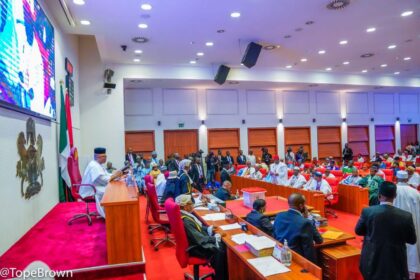
When soldiers attempted to overthrow the government of Benin Republic, Nigerian aircraft and troops were deployed with remarkable speed after Benin requested assistance. Tinubu secured legislative approval, defended constitutional government across the border, and demonstrated that Nigeria still possesses real military capacity when its president chooses to use it.
Reuters
So the excuses collapse. The military is not too weak. The state is not too slow. The chain of command is not too broken. Everything that Nigerians are told is impossible inside Nigeria was made possible, within days, for a government in Cotonou. Why is a foreign presidency worth that urgency when a Nigerian village is not?
Look at Rivers State. Tinubu declared emergency rule, suspended an elected governor, deputy governor and an entire legislature, and installed a retired Vice Admiral, Ibok-Ete Ibas, as his administrator. The Nigerian Bar Association condemned the removal of elected officials as unconstitutional. It made no difference. The machinery of federal power moved the same day.
Associated Press
Understand what this means. The full weight of the Nigerian state can be mobilised overnight to remove people who were elected, and cannot be mobilised over months to remove people who are killing. Elected governors are dealt with in hours. Armed bandits are dealt with in press releases.
The children of St Mary’s Catholic School in Papiri, Niger State, were eventually released in stages over roughly a month. Their freedom is a mercy, and I do not diminish it. But a month is not a triumph, and the circumstances remain deliberately opaque. More than 300 pupils and staff were originally reported abducted; some escaped, and the rest were subsequently freed. Reuters: A serious government would by now have told the nation how armed men transported hundreds of children across its territory, where they were held, who fed them, who negotiated, whether money or concessions changed hands, and which officials have been dismissed or charged for the failure that allowed it. Instead there is silence, and silence in Nigeria is never an accident. It is a policy. It protects whoever needs protecting.
Tinubu found his voice quickly enough when he threatened military action against Niger after its coup. As ECOWAS chairman, he was eager to discipline neighbouring African countries in the language of sovereignty and constitutional order. That language has never once been turned, with the same conviction, on the terrorists, kidnappers, illegal miners and criminal financiers operating openly inside his own borders. A man who will threaten war on Niamey but will not name the sponsors of terror in Zamfara has revealed which enemies he is prepared to have.
He is strong against elected institutions in Rivers State.
Strong against coup-makers in neighbouring countries.
Strong when the interests of political allies require defending.
Strong when travelling abroad, surrounded by foreign leaders and photographed in foreign capitals.
But before the widows of Plateau, the parents of Niger State and the communities terrorised from Benue to Katsina, the presidency is distant, ceremonial and painfully slow. It arrives late, stays briefly and leaves without answers.
There is one more absence that Nigerians should not be talked out of noticing. Throughout a period of intense controversy over the release of American law-enforcement records connected to him, Tinubu has conspicuously avoided an official visit to the United States. He is comfortable in Paris. He is comfortable in a dozen other capitals. He is not comfortable in the one country where questions about his past are being litigated in open court. Avoidance is not proof of guilt, and there is no established evidence that any foreign intelligence service “controls” him; I make no such claim. But a president who travels everywhere except the place where scrutiny waits for him has forfeited the right to lecture anyone about accountability. Nigerians are entitled to ask the plain question: what is it about Washington that he does not wish to face?
What does The Art of War say about such a leader?
Sun Tzu teaches that speed is the essence of war, but speed must serve a coherent objective. Tinubu has proven beyond a doubt that he can act quickly. The problem, therefore, is not incapacity. It is choice. When a commander is fast for himself and slow for his people, that is not weakness. It is a decision about whose survival matters.
Sun Tzu teaches that a commander who knows neither himself nor his enemy will lose every battle. Nigeria cannot defeat terrorism while its government refuses to name the financiers, the political sponsors, the supply networks and the officials who shield the killers. You cannot fight an enemy you decline to identify. And a government that declines to identify him invites the suspicion that it already knows exactly who he is.
Sun Tzu teaches above all that victory depends on the people being of one mind with their ruler. A ruler cannot demand sacrifice from citizens he neither protects nor trusts. Fear can purchase obedience for a season. It has never purchased a nation.
My judgment is this. Bola Tinubu is not governing as the father of a wounded republic. He is governing as the manager of a political fortress: swift when the walls of power are threatened, indifferent when blood flows beyond the gates. The Benin deployment, the Rivers takeover, and the Niger ultimatum were not aberrations. They were the real Tinubu. The airport in Jos was the real Tinubu too. The difference between them is not capacity. It is whom he considers worth the effort.
That is not strategic leadership. It is selective strength, and selective strength is the signature of a man defending an office rather than a country.
Nigeria does not need a president who is brave only against governors, protesters and weaker African neighbours. It needs a president who confronts terrorists with the same speed he confronts his rivals, who protects children as urgently as he protects his allies, who comforts victims in their villages and not on a runway, who respects the Constitution he swore to uphold and who submits himself to scrutiny wherever legitimate questions follow him, including across the Atlantic.
The Nigerian presidency is not a private bunker. It belongs to 230 million people.
The first duty of its occupant is not to protect his throne.
It is to protect Nigerians. On the evidence of his own conduct, Bola Tinubu has chosen the throne.