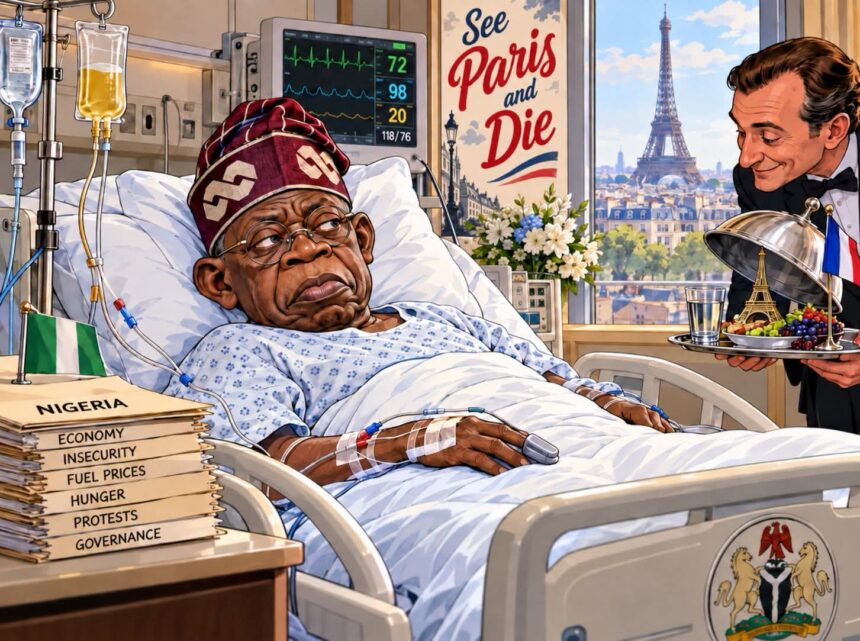
Twenty-nine days in, the Presidency finally answered a question nobody asked, and left the one everybody did.
On Sunday night, after weeks of mounting questions about where their president actually was, Nigerians finally got a statement from the Presidency. It answered none of them.
“Nigeria’s President is hale and hearty,” said Bayo Onanuga, the Special Adviser on Information and Strategy, in a post on X responding to inquiries from THISDAY. “He has been on a working vacation, which he is perfectly entitled to. In this digital age, he does not need to be physically present in Abuja to do the work for which he was elected in 2023.”
Nobody had asked whether Bola Tinubu was ill. That question belongs to the fever swamps of social media, not to the National Assembly or to this newspaper. The question this newspaper has actually been asking, across two previous editorials, is a different one entirely, and the Presidency’s statement walked straight past it: not is he well, but why, twenty-nine days into a trip announced as three weeks, is he still not home — and what, precisely, has that additional time bought Nigeria?
The timeline the Presidency would rather you forget
President Tinubu left Nigeria on August 30 for London, then Paris, on what the Presidency called a three-week annual vacation. Three weeks from August 30 is September 20. On September 21, with no sign of him, the Presidency announced the vacation had been extended “by a few days” and that he would return “at the weekend.” That weekend came and went. By Monday this week, his absence had entered its 29th day, and the Presidency was once again promising a return “this week” — now tied, conveniently, to Thursday’s Independence Day.
Extensions announced only after the original deadline has already quietly expired are not itineraries. They are a government discovering, in real time, that it has to keep explaining itself, and choosing to do so one vague sentence at a time rather than all at once.
What “working” bought Nigeria: one bridge, not built by him
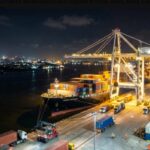
Asked what the extra time produced, Onanuga pointed to one thing: “meeting investors in France, most recently facilitating a $7 billion deep-sea port in Ogun Waterside, an initiative of the Ogun State Government.”
Read that sentence as carefully as the Presidency hoped nobody would. It is an initiative of the Ogun State Government. The agreement, for the Gateway Deep Seaport and Blue Marine Special Economic Zone, was signed on September 24 between Ogun State and the Dubai ports operator DP World. Nobody disputes that Tinubu was present, or that his presence at a signing carries diplomatic weight. But “facilitating,” in Onanuga’s telling, has been asked to do the work of “personally negotiated and delivered,” and those are not the same claim. A state government’s port deal, witnessed by a visiting president, is not evidence of what a president spent four weeks of his own working time doing. It is evidence that Ogun State’s officials did their jobs while he was in the room.
If there is a fuller ledger — other agreements signed, other investors committed, other outcomes with numbers attached — the Presidency has had four weeks to compile it and has offered one port deal that belongs to someone else. Nigerians are entitled to ask whether that is the whole file, or merely the only page anyone thought to show them.
The comparison that falls apart on contact
Onanuga’s second line of defence was that Tinubu is not alone: South Africa’s Cyril Ramaphosa and Egypt’s Abdel Fattah el-Sisi also skipped the UN General Assembly this year, and nobody in Johannesburg or Cairo “erupted.” Strictly true, and strictly beside the point, because the comparison collapses the moment you look at why each man was absent.
Ramaphosa’s office confirmed in mid-September that doctors had ordered him to rest after returning from the BRICS summit in India, and named Foreign Affairs Minister Ronald Lamola as his stand-in for the debate itself. That is a stated medical reason, publicly attributed, with a named substitute for a specific event — even if South African reporters couldn’t resist noting he was well enough to play golf at a fundraiser the same week. El-Sisi’s absence required even less explanation, because Prime Minister Mostafa Madbouly attending “on behalf of the president” is not a break from precedent — Egypt did the same thing at UNGA 80 the year before. Routine is not a scandal.
Tinubu’s case matches neither pattern. He is not unwell — the Presidency itself insists on that point, loudly. He is not following an established practice — no Nigerian president has skipped the General Assembly and then stayed abroad for a month afterward, extending a personal vacation past its own announced end date without explanation. Ramaphosa had a doctor’s note. Sisi had a precedent. Tinubu has “which he is perfectly entitled to” — a defence of his right to take a vacation, offered in response to a question about his obligation to account for one that has run more than a week past its own deadline.
A president in Paris while the President of France was in New York
There is one image from this month that no amount of spokesman’s language will soften. Emmanuel Macron, who had hosted Tinubu at the Élysée Palace, flew to New York, addressed the General Assembly on behalf of his own country, and flew home. Tinubu remained in Macron’s capital the entire time. Nigeria’s head of state did not represent Nigeria at the one annual forum built for exactly that purpose. He stayed behind in the seat of a foreign government while that government’s own president did the job Tinubu’s spokesman insists doesn’t require physical presence.
Nigeria did not need him to keep house in Paris. It needed him to speak for Nigeria in New York, or to explain, specifically and promptly rather than four weeks and two deadline extensions later, why he would not.
Coming home for a movie
Here is the detail that belongs in the record. Announcing the return this week, Onanuga said Tinubu would be back in time to mark Independence Day — and to attend the Lagos premiere of a film honouring MKO Abiola. This newspaper takes nothing away from Abiola’s memory, which deserves better than being reduced to an argument on either side of this one. But it is worth sitting with the plain fact of it: the event drawing the President home, as named by his own office, is a film premiere. The event that did not was the United Nations.
What would actually answer the question?
This newspaper is not asking for an apology, and it is not asking Tinubu to account for every hour. It is asking for what any employer would ask of any employee who extended unexplained leave twice past its own deadline: a plain list. The full schedule of substantive engagements conducted during four weeks abroad. The agreements actually signed by the Nigerian government, as distinct from state governments he happened to witness. The investors actually committed, with figures. Nigeria’s president has run a country from three time zones away in a “digital age” his own spokesman invokes as though geography no longer matters to governance. If it truly doesn’t, proving it is simple: publish the record, and let Nigerians judge the output against the twenty-nine days it took.
Nigeria, not France, needed the housekeeping this month. Nigerians are still waiting to be shown what got done instead.
This is a United Continental Post editorial. It draws on statements by Presidential Special Adviser Bayo Onanuga as reported by THISDAY, Channels Television, Tribune Online, Naija News, allAfrica and National Accord; ADC and Labour/NDC statements reported by allAfrica and OsunDefender; and reporting on the September 24 Ogun–DP World signing and the South African and Egyptian UNGA arrangements by OkayAfrica and CNBC Africa.