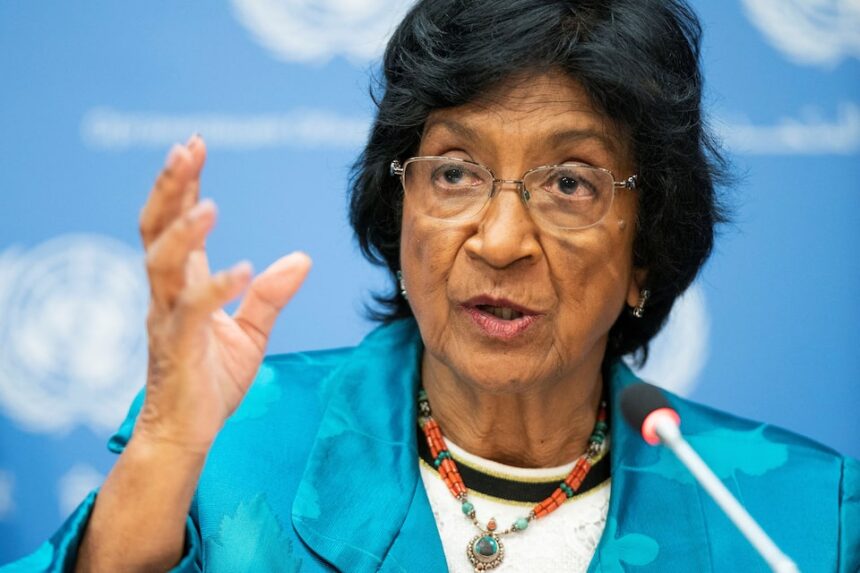
Former International Criminal Court (ICC) judge Navi Pillay has won the 2026 Nobel Peace Prize for her efforts to promote peace and international law, amid mounting pressure on international judicial institutions and renewed disputes over accountability for alleged international crimes.
The Norwegian Nobel Committee announced the award on Friday, October 9, recognising the 85-year-old South African jurist for her decades-long commitment to human rights, justice and the rule of law. The committee said the international legal system was under tremendous pressure, warning that the growing influence of power politics threatened established legal frameworks and peaceful coexistence.
Pillay, who previously served as United Nations High Commissioner for Human Rights from 2008 to 2014, has held several prominent positions in international justice, including serving as a judge at the ICC and the International Criminal Tribunal for Rwanda. She also chaired a United Nations Commission of Inquiry on the Occupied Palestinian Territory, which concluded in a report last year that Israel had committed genocide in Gaza. Israel rejected the findings as scandalous.
The award came on the same day the United States imposed sanctions on the ICC, escalating its campaign against the court following its issuance of arrest warrants for Israeli Prime Minister Benjamin Netanyahu and his former defence minister. US President Donald Trump has repeatedly criticised the institution and urged countries to withdraw from it.
Although the Nobel Committee did not directly mention Trump or Israel in its citation, its emphasis on defending international law highlighted concerns over growing challenges to the institutions responsible for international accountability.
Pillay received news of the award while attending a legal conference in Nuremberg, Germany, a city closely associated with the post-Second World War trials of Nazi leaders. Speaking after the announcement, she recalled that her most recent work had involved delivering the UN report on Gaza, which characterised the situation there as genocide.
She later dedicated the award to survivors of international crimes and to those working to defend international justice, stressing that impunity must not be allowed to prevail. Addressing world leaders, Pillay said they were legally obliged to protect human rights and refrain from war.
United Nations High Commissioner for Human Rights Volker Türk welcomed the recognition, describing it as a collective victory for human rights and for those pursuing justice and accountability worldwide.
Türk, who worked with Pillay during her tenure as UN human rights chief, praised her as an embodiment of international law. He said the award reinforced the importance of international criminal accountability mechanisms, including the ICC, at a time of profound challenges to the global legal order.
ICC President Tomoko Akane also welcomed the Nobel Committee’s decision, describing the recognition as particularly significant given the mounting challenges facing international justice institutions.
However, the award drew a sharp reaction from Netanyahu’s office, which accused the Nobel Committee of losing its moral compass and alleged that Pillay had built her career around spreading false accusations against Israel. The response reflected the continuing controversy surrounding the UN commission’s findings on Gaza.
Born in Durban, South Africa, to a family of Indian Tamil origin, Pillay made history in 1967 as the first woman to establish a law practice in Natal. Following the end of apartheid, she became the first non-white woman to serve on South Africa’s High Court.
Her career has been marked by efforts to hold governments and national leaders accountable under international law. The Nobel Committee highlighted the continuity between her early work defending Nelson Mandela and other opponents of apartheid and her later service in international courts dealing with some of the world’s most consequential cases.
Pillay continues to serve as a judge at the International Court of Justice, where she is involved in proceedings concerning allegations that Myanmar committed genocide against the Rohingya.
She becomes the fifth South African Nobel Peace Prize laureate, following Nelson Mandela and FW de Klerk, Archbishop Desmond Tutu and Albert Luthuli.
The Nobel Peace Prize carries an award of 12 million Swedish kronor, approximately $1.2 million, and will be presented in Oslo on December 10, the anniversary of the death of Alfred Nobel, who established the prizes in his will.