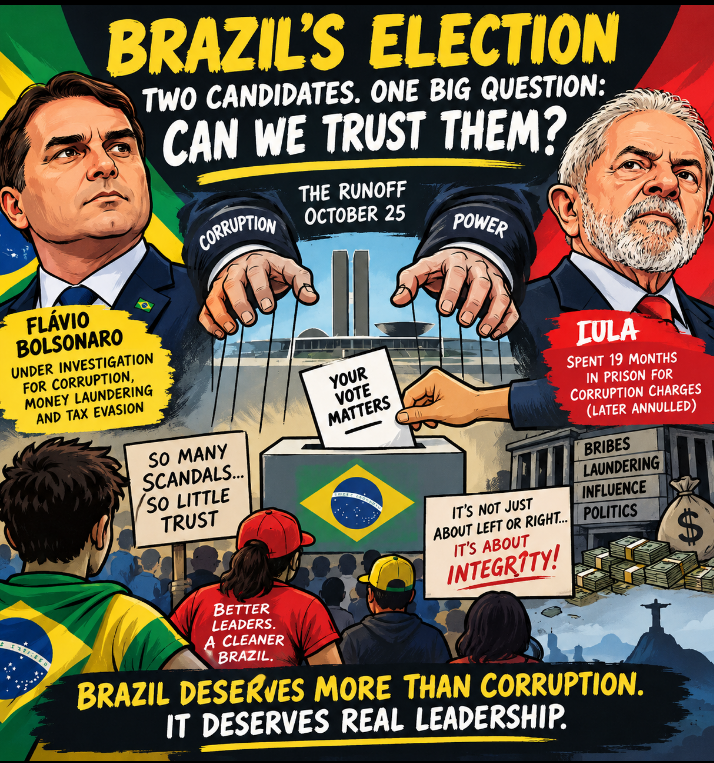
As Brazil prepares for its October 25 presidential runoff between far-right candidate Flávio Bolsonaro and incumbent Luiz Inácio Lula da Silva, the country’s political future is overshadowed by an unsettling question: why must the fate of millions of citizens remain in the hands of political figures whose records are clouded by corruption allegations or past criminal convictions?
The contest is not merely a battle between the right and the left; it is a troubling reflection of a democracy struggling to offer its people credible alternatives to leaders whose personal and political histories have become subjects of intense public scrutiny.
Corruption has emerged as a major concern for Brazilian voters, but its greatest threat may not be the advantage it gives one candidate over another. Rather, it is the growing disillusionment it breeds among citizens who increasingly believe that their political system offers them little more than a choice between competing controversies. When voters begin to see the ballot as a selection between the lesser of two evils, democracy may remain functional on paper while losing the public confidence necessary for its survival.
Bolsonaro is under investigation over allegations of corruption, money laundering and tax evasion, while Lula spent 19 months in prison after being convicted on corruption and money laundering charges. Those convictions were subsequently annulled, meaning they no longer stand as valid convictions. The distinction is important: an investigation is not proof of guilt, just as an annulled conviction cannot be presented as a subsisting judicial judgment. Nevertheless, the controversies surrounding both political figures have placed questions of integrity at the centre of Brazil’s electoral debate.
The deeper problem, however, extends beyond the legal circumstances of the two candidates. It concerns a political culture in which powerful personalities, entrenched loyalties and partisan calculations can become more influential than character, accountability and public service. Rather than demanding higher standards from those seeking to govern them, sections of the electorate appear willing to overlook serious allegations against their preferred candidates, provided the opposing camp is prevented from winning. In such an environment, political competition becomes less about who can govern best and more about which side can defeat the other.
Political science professor Nara Pavão of the Federal University of Pernambuco argues that voters are often capable of filtering out information that contradicts their existing beliefs. This tendency helps explain why allegations against a favoured politician may have little effect on committed supporters. For many, the immediate objective is not necessarily to establish the truth about their candidate but to ensure the defeat of their political opponents. Such reasoning is dangerous because it transforms loyalty into a shield against accountability and makes it increasingly difficult for public scrutiny to influence electoral decisions.
Yet a country cannot build a credible future on the assumption that the faults of one political camp excuse those of another. The question should not be whether Bolsonaro is preferable to Lula, or whether Lula is preferable to Bolsonaro, simply because one is associated with the political right and the other with the left. The more fundamental question is whether Brazil’s political system can produce leaders whose credibility rests on demonstrable integrity, sound policies and a commitment to the public interest rather than on the ability to mobilise partisan resentment.
The consequences of this political disillusionment are already visible in voter participation as more than 33 million Brazilians, representing approximately 21 per cent of the electorate, abstained from voting in the October 4 first round.
It was the highest first-round abstention rate since 1998 though abstention can have several causes, analysts say repeated corruption scandals and public disenchantment with politics can discourage citizens from participating in elections. The danger is that those who withdraw from the democratic process may leave the country’s direction increasingly dependent on the most committed partisan constituencies rather than a broad and representative electorate.
José Tainan, a 36-year-old kitchen assistant from Rio de Janeiro, said corruption was the principal reason he stopped voting. In his view, neither candidate represents a satisfactory choice. His position reflects a painful democratic paradox: citizens are told that their votes determine the future yet some feel so alienated by the available choices that they would rather stay away from the ballot box.
His frustration deserves serious consideration. Elections should offer citizens a meaningful opportunity to choose leaders they trust, not force them repeatedly to select candidates they regard as unacceptable.
When a voter concludes that neither of the leading contenders deserves support, the failure cannot automatically be blamed on voter apathy. It may also reveal a deeper failure of political parties to cultivate credible leadership and of the wider political system to make integrity a decisive qualification for public office.
Nevertheless, abstention is not necessarily the most effective answer. In Brazil, voting is compulsory for citizens aged 18 to 70, subject to recognised exemptions, and failure to vote without a valid justification can attract a small fine. More importantly, withdrawing from elections does not remove controversial politicians from power. It can instead weaken the collective influence of citizens who want better governance, allowing the most organised political factions to exercise disproportionate influence over the outcome.
The debate has also been complicated by the Banco Master scandal, which has drawn scrutiny to alleged connections involving powerful political and judicial figures. Supreme Court Justice Alexandre de Moraes and Flávio Bolsonaro have both been linked in reports to the bank’s former head, although both have denied wrongdoing.
The allegations have intensified public debate about the relationship between political power, the judiciary and financial interests. They must, however, be investigated through credible and independent processes rather than treated as proof of guilt before the facts are established.
For many Brazilians, the controversy evokes memories of Operation Car Wash, the sweeping corruption investigation launched in 2014 that implicated numerous politicians and business figures. The enduring lesson is that corruption is not merely a collection of individual scandals. It can undermine public institutions, distort the allocation of national resources, weaken confidence in the justice system and create the perception that influential individuals operate under different rules from ordinary citizens.
This is where Brazil’s political crisis becomes a question of national conscience. Why should the destiny of an entire country remain trapped within a narrow circle of political personalities whose records repeatedly provoke questions about integrity, accountability and the exercise of power?
A democracy should not have to choose between competing controversies as though credible leadership were an unattainable luxury. Neither political popularity nor ideological loyalty should place any candidate beyond scrutiny, and no individual should be entitled to public trust merely because supporters fear the alternative.
The problem is not that politicians accused of wrongdoing must automatically be excluded from public life. Such a principle would disregard due process and risk turning allegations into political weapons. Rather, the problem is the apparent willingness of political parties and voters to subordinate integrity to electoral convenience. Where convictions have been lawfully annulled, the legal consequences must be respected; where allegations remain under investigation, the evidence must be examined fairly. But voters are equally entitled to assess the judgement, conduct, transparency and credibility of those seeking the highest office in the land.
Political parties therefore have a responsibility that extends beyond winning elections. They must develop credible candidates, strengthen internal accountability and demonstrate that public office is a responsibility rather than a personal entitlement. Electoral institutions must safeguard the integrity of the process, while law enforcement and the judiciary must investigate allegations impartially, without favouritism or political interference. Above all, citizens must reject the dangerous notion that the misconduct of their preferred candidate becomes acceptable whenever the opposing candidate is considered worse.
Brazil’s predicament also offers a warning to democracies elsewhere, particularly countries where political loyalty frequently overrides accountability and where the same powerful figures continue to dominate the leadership conversation despite persistent public controversy. A country cannot indefinitely renew its political future by recycling the same divisions, excusing the same failures and expecting different results. When the public is repeatedly forced to choose between personalities rather than principles, democratic institutions risk becoming instruments for preserving political power instead of advancing the common good.
Ultimately, Brazil’s October 25 runoff will determine whether Bolsonaro or Lula receives the mandate to govern. But the more consequential test will be whether the country’s democracy can recover the public confidence that corruption scandals and partisan hostility have eroded. Whoever wins must understand that electoral victory is not a declaration of personal innocence, nor is it a licence to govern without accountability. The winner must demonstrate through transparent governance, respect for the rule of law and measurable improvements in citizens’ lives that public office remains a trust.
A nation deserves more than a choice between familiar political adversaries whose records have become a source of public controversy. It deserves a political culture in which integrity is a qualification for leadership, accountability is non-negotiable and no politician is considered indispensable. If Brazil’s democracy is to move beyond its present predicament, voters and political parties must stop treating the defeat of the opposing camp as the ultimate measure of political success. The true measure of democracy is not simply who wins an election, but whether the people can trust those entrusted with their future.