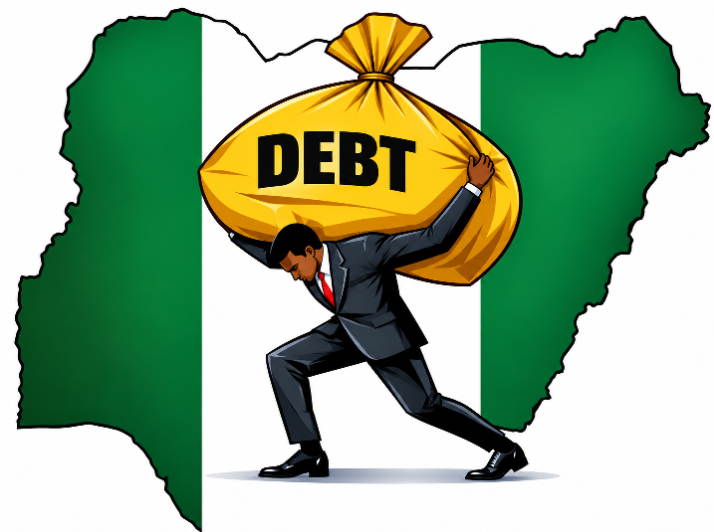
Former President Olusegun Obasanjo has strongly criticised President Bola Tinubu’s defence of government borrowing, warning that excessive debt could burden generations of Nigerians.
Obasanjo, who spoke on Friday at the Ajibosin Platform, a public forum in Abeokuta, Ogun State, described as “absolute nonsense” Tinubu’s assertion that borrowing should not be viewed negatively, arguing that its consequences extend far beyond the present generation.
The forum, themed Leveraging Artificial Intelligence to Solve Grassroots Problems and Accelerate National Development, provided the platform for the former president to question Nigeria’s economic management and the decisions of its political leadership.
In April, Tinubu defended his administration’s borrowing policy during a meeting with Plateau State leaders at the State House, insisting that loans could be necessary to finance government activities, provided the country worked hard to repay them.
“If we have to borrow, we borrow. Borrowing is not leprosy, we just have to work hard to be able to pay for it,” the president said.
However, Obasanjo rejected the comparison, arguing that the consequences of debt were more far-reaching than those of the disease.
“And for anybody to say debt is no leprosy, is absolute nonsense. Debt is worse than leprosy. Because leprosy destroys only one person. Debt destroys generations,” he said.
The former president also expressed concern over the naira’s depreciation, questioning Nigeria’s economic performance over the past four decades.
Recalling that the naira exchanged at N1 to $1.85 when he started his farm 47 years ago, Obasanjo asked what the country had achieved to justify the currency’s subsequent decline to about N1,500 to the dollar.
“When I started my farm, 47 years ago, naira to the dollar was one naira to $1.85. Forty-seven years ago. What has Nigeria done in 47 years that we now have 1,500 naira to the dollar? What have we done?” he asked.
He further questioned the competence of Nigeria’s political leadership, asking whether those in power possessed the knowledge and capacity to make decisions that would improve citizens’ living conditions.
Obasanjo also criticised Nigeria’s reliance on the World Bank and the International Monetary Fund (IMF), arguing that their economic prescriptions might not adequately reflect the country’s peculiar circumstances.
He recalled that Nigeria had been discouraged from subsidising agriculture despite the support available to farmers in developed economies.
“World Bank and IMF were not designed for us. They were not built by us. They were built before we became independent. And that’s the people who would determine what we do,” he said.
The former president cautioned against unquestioningly adopting economic policies recommended by foreign-trained experts without considering Nigeria’s specific needs and realities.
Meanwhile, the presidential candidate of the Nigeria Democratic Congress (NDC), Peter Obi, has accused Tinubu of borrowing nearly $100 billion over the past three years without adequately accounting for how the funds were spent.
Obi made the allegation on Friday in Yenagoa, Bayelsa State, during the homecoming of the party’s national leader, Senator Seriake Dickson, and the commissioning of its secretariat.
He called on Nigerians to reject the ruling All Progressives Congress (APC), accusing the administration of lacking the competence and compassion required to govern the country.
According to Obi, widespread poverty, hunger, inadequate healthcare, poor access to education and unemployment reflect the challenges confronting Nigerians under the current administration.
“Our president has borrowed nearly $100 billion, nobody knows what he did with the money, we want the president to come and explain to Nigerians what he used the money he borrowed to do in the past three years,” Obi said.
He also questioned Tinubu’s capacity to continue governing, alleging that the president had become tired of managing the country’s affairs.
Obi said the NDC intended to pursue an economic model focused on domestic production rather than consumption, arguing that Nigeria needed a government capable of addressing poverty, creating jobs and improving essential public services.
“Today we have a country that produces the highest number of poor people in the world. Today we have a country where our people are hungry, Nigerians don’t know where the next meal will come from anymore,” he said.
He added that the country needed leadership capable of translating its resources into better living conditions for its citizens.